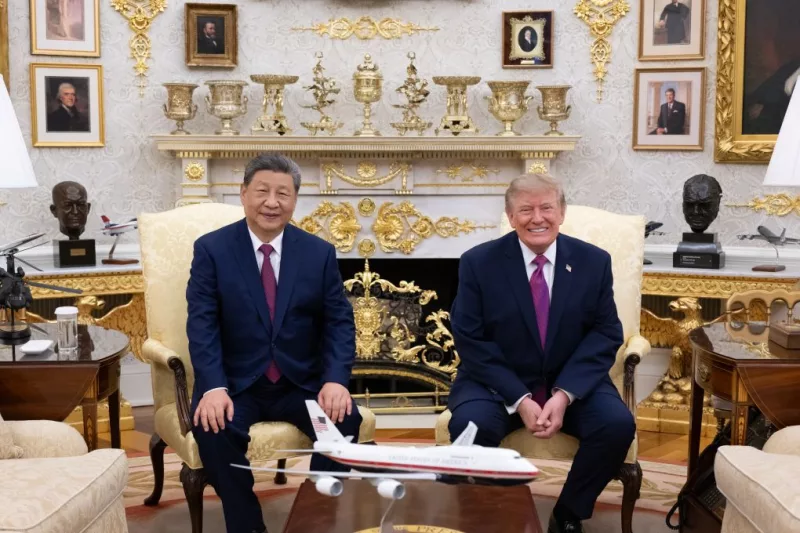
China and the United States have agreed on a new framework to manage their rivalry, with eight key outcomes. The agreement was reached during a three-day state visit by Chinese President Xi Jinping to the US, which ended on Friday. The framework aims to stabilise relations between the world's two largest economies, reducing uncertainty created by years of tensions between Beijing and Washington.
The agreements cover a range of areas, including trade, artificial intelligence, counternarcotics, global economic cooperation, and security. The two leaders, Xi and US President Donald Trump, agreed to build a "constructive China-US relationship of strategic stability based on respect, fairness, and reciprocity." This relationship aims to prevent differences from turning into a wider confrontation.
The economic component of the agreement is significant, with China and the US agreeing to establish and advance mechanisms such as a trade council and a Board of Investment. A $30 billion reciprocal tariff reduction arrangement covering non-sensitive goods was also agreed upon. The White House said the two sides had reached consensus on more favourable tariff treatment for $30 billion of non-sensitive goods in each direction.
The agreement also provides for a working group on agricultural market access, and China and the US appear to be shunning repeated tariff confrontations in favour of a structured system for managing economic disagreements. Businesses and economies that depend on global supply chains stand to benefit from this new approach. The significance of the talks goes beyond the two countries, as China and the US are major players in global trade, manufacturing, technology, and finance.
The two leaders also agreed to support each other as hosts of major international economic meetings next year. China will host the APEC Economic Leaders' Meeting in November 2026, while the US will host the G20 Leaders' Summit in December. Xi and Trump expressed their intention to attend each other's meetings, demonstrating a willingness to cooperate on global economic issues.
China and the US have also opened a new area of cooperation around artificial intelligence, with the leaders agreeing to establish a China-US AI dialogue. This dialogue will provide a platform to exchange views on the risks and benefits associated with AI. The next round of discussions is expected in November, and the two sides will also establish a communication channel for AI-related incidents.
The agreements do not remove the underlying competition between Beijing and Washington, but they do provide a foundation for cooperation on key issues. Xi said the future of China-US relations would require the two sides to strengthen communication and cooperate with sincerity. Trump described the visit as constructive, saying the two sides had achieved positive outcomes that would benefit both countries.
Key points
- China and US agree on new framework to manage rivalry, covering trade, AI, and security.
- The two countries agree to establish a Board of Investment to provide a structured channel for discussing investment opportunities.
- China and US agree to cooperate on artificial intelligence, establishing a dialogue to exchange views on risks and benefits.