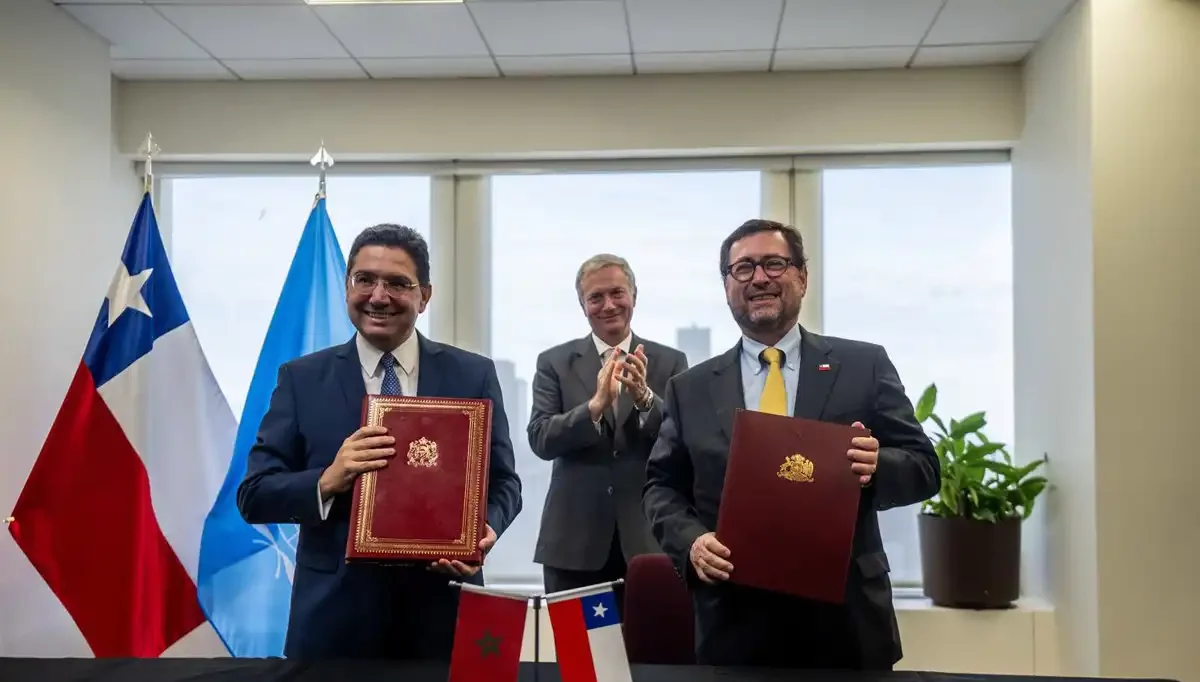
Chile has recognized Morocco's sovereignty over the Sahara region, according to a joint communiqué signed on September 22 in New York by Moroccan Foreign Minister Nasser Bourita and his Chilean counterpart Francisco Pérez Mackenna. The statement marks a significant development in the long-standing dispute over the region. The recognition is based on Morocco's 2007 autonomy initiative, which Chile supports as a viable solution to the conflict. This move aligns with UN Security Council Resolution 2797, which calls for negotiations in good faith without preconditions.
The joint communiqué comprises three main components. Politically, Chile's recognition of Moroccan sovereignty is a crucial step towards resolving the regional dispute. Economically, Chile has pledged to encourage direct investments in Morocco's southern provinces, focusing on agro-industry, renewable energy, and logistics. This commitment is expected to boost economic cooperation between the two nations. The third component involves trade, with Chile and Morocco agreeing to negotiate a free trade agreement in line with World Trade Organization rules.
The combination of political recognition, investment commitments, and trade agreements makes Chile's announcement significant. By creating economic interests, Chile's position becomes more difficult to revise, going beyond a mere statement of principle. This development is particularly noteworthy given Chile's previous stance on the issue, as it belonged to a group of Latin American countries that were most reserved on the matter.
Chile's shift in stance is part of a broader trend in Latin America. Just a day before Chile's announcement, Panama affirmed its recognition of Moroccan sovereignty and began exercising its consular competencies over the entire Moroccan territory. Cabo Verde also reaffirmed its support for Morocco, as stated by its Foreign and Defense Minister, Manuel Augusto Lima Amante da Rosa.
This series of events occurs with the UN Security Council's review of the mandate of the UN mission in the Sahara approaching, with the current mandate set to expire on October 31. The timing of Chile's announcement coincides with the 65th anniversary of diplomatic relations between Chile and Morocco, adding a celebratory tone to the development.
The recognition by Chile and other Latin American countries may have implications for the international dynamics surrounding the Sahara dispute. Morocco's sovereignty over the region has been a contentious issue for decades, with various countries and organizations taking different stances. The growing support for Morocco's position could influence future negotiations and the ultimate resolution of the conflict.
As the international community continues to engage with the Sahara dispute, Morocco's diplomatic efforts appear to be yielding results. With Chile's recognition and the support of other countries, Morocco's position is likely to gain further traction. The negotiation of a free trade agreement between Chile and Morocco will be an important step in strengthening bilateral relations and may serve as a model for future economic cooperation.
Key points
- Chile recognizes Moroccan sovereignty over Sahara, supports autonomy initiative
- Chile and Morocco agree to negotiate a free trade agreement
- Recognition by Chile and other Latin American countries may influence international dynamics on the Sahara dispute