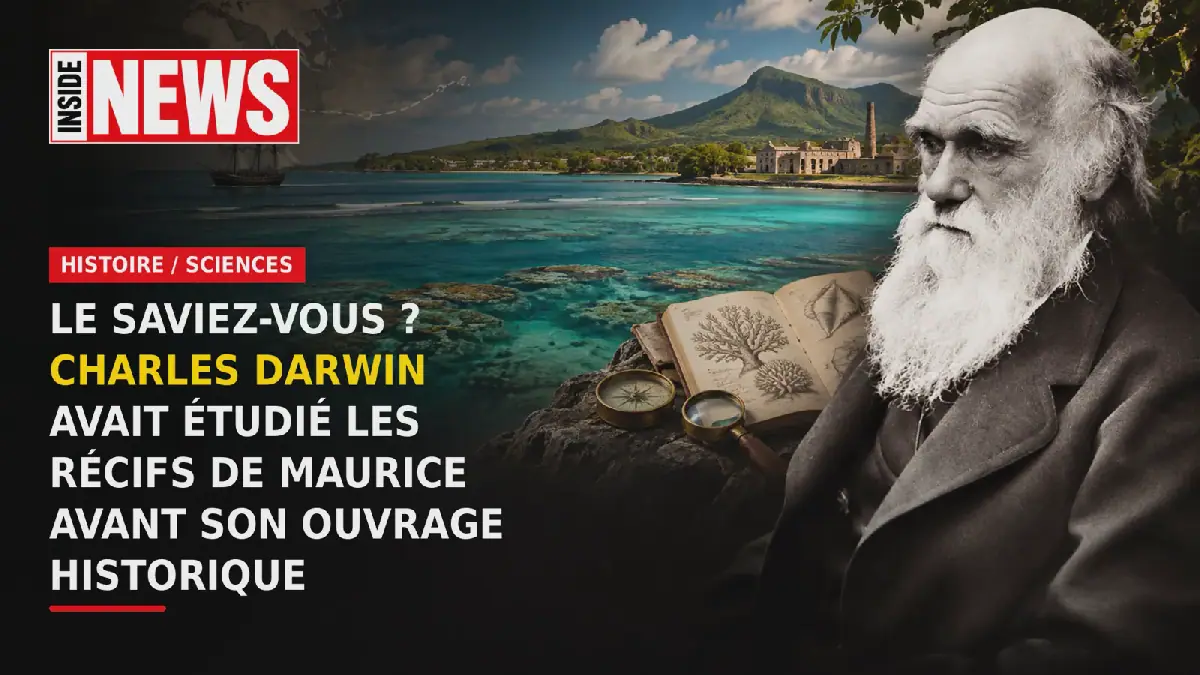
On November 24, 1859, Charles Darwin's book, On the Origin of Species, was published in London, revolutionizing the field of biology. However, 23 years prior, Darwin had stopped in Mauritius, where he investigated a different mystery. During his stay, he studied coral reefs and wondered how they could form rings in the middle of deep oceans. His field notes provide insight into his research in the waters of Grand-Port.
Darwin's research vessel, The Beagle, anchored in Port-Louis on April 29, 1836, and departed on May 9. In his geological journal, he initially described the island's lava flows and relief. He then turned his attention to the ocean, noting the height of the coral reef off Grand-Port and identifying the main channel where freshwater flowed. This local detail allowed him to compare the coral arrangement to those he observed in other parts of the Indian Ocean, including the Cocos (Keeling) Islands.
Darwin's research on coral reefs led him to develop a theory on how they form and survive. He proposed that if a volcanic island slowly sank, the coral surrounding it could continue growing towards the surface. A lagoon could then form between the shore and the reef. If the island eventually disappeared underwater, a coral ring could remain around the lagoon. His research in Mauritius provided a comparative site to study fringing reefs.
In 1842, Darwin published his findings on coral reefs in The Structure and Distribution of Coral Reefs. The second edition of this book was published between late May and early June 1874. His work on species evolution, including the concept of natural selection, was presented to the Linnean Society of London in 1858, along with Alfred Russel Wallace's research. This eventually led to the publication of On the Origin of Species in 1859.
Darwin's field notes and geological journals from his time in Mauritius provide valuable insights into his research. The Darwin Correspondence Project has documented the chronology of On the Origin of Species, while Cambridge University has records of the revised edition of The Structure and Distribution of Coral Reefs. These resources offer a glimpse into Darwin's research and thought process during his time in Mauritius.
The coral reefs and geological formations in Mauritius played a significant role in shaping Darwin's theories. His observations of the island's geology and coral reefs helped him develop his ideas on the long-term processes that shape our planet. This research ultimately contributed to his groundbreaking work on species evolution.
Today, researchers can still study Darwin's notes and journals from his time in Mauritius, providing a unique perspective on his research and discoveries. By examining his field notes and publications, scientists can gain a deeper understanding of the development of his theories and the significance of his research in the field of biology.
Key points
- Darwin's research in Mauritius influenced his theory on coral reefs and species evolution.
- His book, On the Origin of Species, was published on November 24, 1859.
- The Structure and Distribution of Coral Reefs was published in 1842, outlining his theory on coral reef formation.