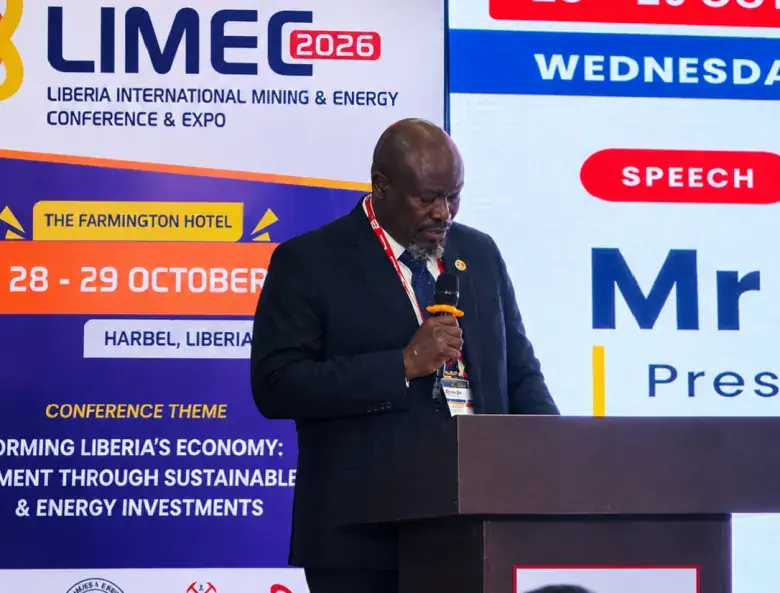
Chamber of Mines President Amara Kamara has called for Liberia's mining industry to deliver greater benefits to citizens. He made the remarks at Liberia's Second International Mining and Energy Conference and Exhibition (LIMEC 2026), which was held under the theme: "Transforming Liberia's Economy: Driving Development Through Sustainable Mining and Energy Investments." Kamara emphasized that the country's mineral wealth must translate into jobs, stronger local businesses, improved infrastructure, better living standards, and lasting benefits to citizens.
President Joseph Nyuma Boakai delivered the keynote address, outlining his government's plans to attract investment and promote the responsible development of Liberia's mineral resources. The event brought together international guests, investors, development partners, technical experts, and business leaders from across Africa and beyond. Their presence underscored growing global interest in Liberia's mineral wealth, energy potential, and prospects for sustainable economic transformation.
Kamara stressed that the success of the sector should go beyond the export of gold, diamonds, and iron ore to include tangible improvements in the lives of Liberians. He said the country must judge the value of its mining industry by the opportunities it creates for its people, including employment, business development, infrastructure, skills transfer, and long-term economic benefits. Kamara emphasized that Liberia has an opportunity to attract investment as global demand grows for critical minerals, renewable energy, and reliable supply chains.
However, Kamara warned that the country's natural resources alone would not guarantee the investment needed to expand the sector. He pointed to the need for reliable geological data, adequate infrastructure, affordable energy, skilled professionals, project financing, transparent regulation, and a predictable investment environment. Kamara argued that Liberia must create the right conditions to move mining projects from exploration to discovery and production while ensuring that the benefits extend beyond mining companies to the wider economy.
Kamara called for sustained investment from international investors, Liberian businesses, development finance institutions, and strategic partners. He stressed that the country needs capital accompanied by expertise, technology, skills development, and a long-term commitment to national growth. Infrastructure and energy are key to mining growth, and Kamara urged Liberia to treat infrastructure development as a national priority rather than an investment intended only to serve individual mining operations.
Kamara identified railway corridors, the Port of Buchanan, the Port of Greenville, and standalone river-barging ports as important opportunities to improve transportation and support economic activities across the country. He also called for greater investment in affordable and reliable electricity, identifying hydropower, solar energy, mini-grids, and hybrid power systems as possible ways to support industrial development and expand access to electricity.
Kamara described local content as a national priority, arguing that Liberian companies should have greater opportunities to supply mining operations, provide technical services, and participate in major infrastructure projects. He also called for greater investment in Liberian geologists, engineers, technicians, environmental professionals, and managers, saying the country needs a skilled workforce capable of taking on more responsibilities in the sector.
Key points
- Amara Kamara calls for Liberia's mining industry to create jobs, build infrastructure, and deliver lasting benefits to citizens.
- Kamara emphasizes the need for reliable geological data, adequate infrastructure, and affordable energy to attract investment.
- Local content is a national priority, with Liberian companies needing greater opportunities to supply mining operations and participate in infrastructure projects.