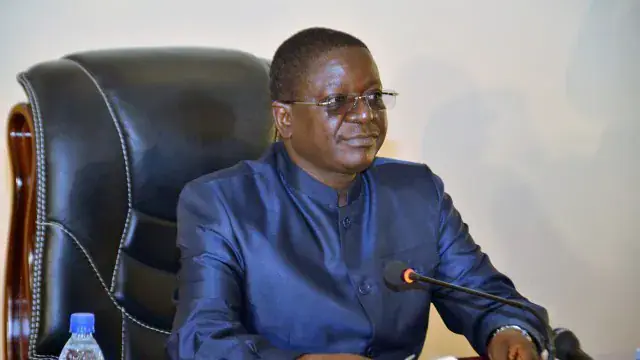
Chad's opposition leader, Pahimi Padacké Albert, has strongly reacted to a statement by the ruling Movement for Patriotism and Salvation's (MPS) Secretary-General, Aziz Mahamat Saleh. Pahimi Padacké Albert, leader of the National Rally of Chadian Democrats (RNDT-Le Réveil), denounced the MPS's exclusionary approach to governance. This criticism comes as Chad faces multiple crises, including a surge in deaths, overcrowded healthcare facilities, and intercommunal conflicts.
Pahimi Padacké Albert expressed concerns about the timing and implications of Aziz Mahamat Saleh's statement, which seemed to reinforce a strict separation between the government's role and that of the opposition. He argued that this approach neglects the complexity of Chad's current situation, marked by violent clashes in several provinces, including Salamat, Guéra, and Hadjer-Lamis, as well as ongoing fighting in Miski.
The opposition leader emphasized that Chad's crises require robust political and institutional responses. He questioned the MPS's formula, "the government governs, the opposition opposes," characterizing it as an outdated concept that has led to exclusionary governance since the beginning of Chad's Fifth Republic. Pahimi Padacké Albert contrasted two approaches to power: one viewing public responsibilities as privileges to be preserved, and the other seeing them as shared responsibilities.
According to Pahimi Padacké Albert, the current government's approach has led to a politics of exclusion, where public responsibilities are treated as a reserved patrimony rather than opportunities for broad participation. He argued that this approach has resulted in repeated instances of political exclusion, stifling the potential for inclusive governance and meaningful opposition engagement.
The RNDT-Le Réveil leader also addressed the human cost of Chad's crises, implying that the ruling party's actions have exacerbated the suffering of ordinary citizens. His comments have reignited debates about the role of opposition parties in Chad's governance and the conditions under which they might participate in the government.
Pahimi Padacké Albert's criticism reflects a deeper tension between Chad's ruling party and the opposition, with implications for the country's ability to address its multiple crises. His call for a more inclusive approach to governance may resonate with some segments of Chadian society, but it remains to be seen how the MPS will respond to these criticisms.
The exchange between Pahimi Padacké Albert and Aziz Mahamat Saleh highlights the challenges facing Chad's democratic development, particularly in terms of promoting constructive engagement between the government and opposition parties. As Chad navigates its complex crises, the opposition's role in shaping the country's future will likely remain a contentious issue.
Key points
- Pahimi Padacké Albert criticizes the MPS's exclusionary politics amid Chad's multiple crises.
- The opposition leader questions the ruling party's approach to governance, advocating for a more inclusive model.
- The debate highlights tensions between Chad's ruling party and opposition, with implications for the country's democratic development.