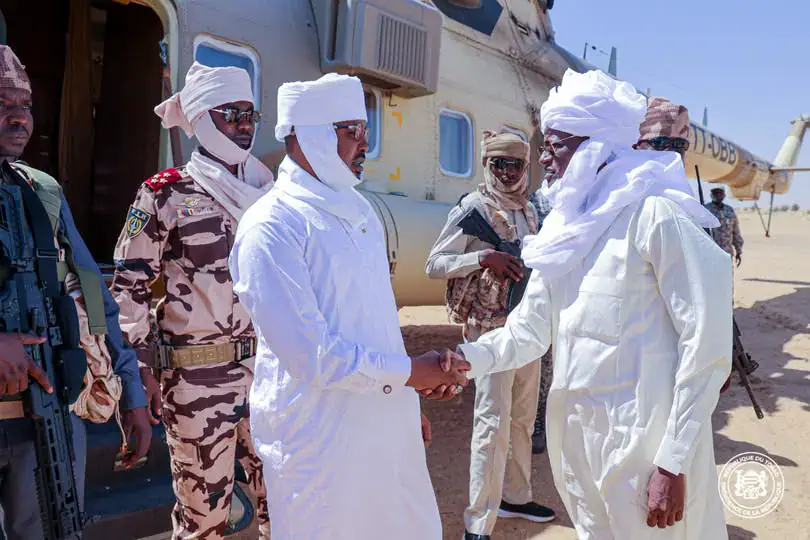
On November 7, 2026, Chad's President Mahamat Idriss Déby Itno arrived in Torboul, a town in the Ennedi Ouest province. His visit came as the region faced a potentially violent conflict over access to water and grazing land. The President met with local military commanders, government officials, and community leaders to address the situation. The talks focused on finding a resolution to the dispute, which had been escalating.
The President's meeting with local officials resulted in several key decisions. The commander of the 8th defense zone, General Hamoda Mahamat Béchir, was suspended, and his deputy took over as interim commander. Additionally, the prefects of Torboul and Mourtcha, as well as the sub-prefect of Am-Djirémé, were relieved of their duties. The President also instructed the director general of the DGSSIE, General Tahir Erda Tahiro, to disarm civilians in the area without delay.
The President justified his decisions by emphasizing that the state is impartial and that officials must serve the state, not their community. He expressed disappointment that previous instructions to disarm civilians had not been carried out. This incident highlights the challenges faced by Chad's security apparatus, particularly in regions where community ties can influence officials' actions. The President's intervention underscores the need for effective mechanisms to manage conflicts and ensure impartiality.
The conflict in Torboul is not an isolated incident. In April, following violence in Dar Tama, a large-scale disarmament operation was launched in eastern Chad, covering several provinces. The presidency cited the risk of spillover from the conflict in Sudan as a reason for prioritizing border security and civilian disarmament. However, the fact that a similar conflict erupted in Torboul, a province near an area supposedly covered by the earlier operation, suggests that the disarmament effort may not have been effective.
The President's comments about community ties and impartiality reflect a broader issue in Chad's security landscape. Analysts have long documented the role of ethnicity and community affiliations in shaping officials' actions and perceptions. In a country where community solidarity is strong, officials may face conflicting loyalties, making it difficult to maintain impartiality in conflicts between different communities.
The incident in Torboul highlights the limitations of Chad's security apparatus and the need for more effective mechanisms to manage conflicts and ensure accountability. The President's direct intervention in the conflict suggests that intermediate control mechanisms are not functioning effectively. The issue of disarmament remains complex, requiring credible and impartial forces to execute it successfully.
The underlying conflict over water and grazing land remains unresolved. Without effective mechanisms for shared management and mediation, such conflicts are likely to persist. The President's visit and decisions in Torboul demonstrate the need for a more comprehensive approach to addressing the root causes of conflicts in Chad's regions. The balance of power within security forces and the representation of different communities remain sensitive topics in Chad's politics.
Key points
- Chad's President Mahamat Idriss Déby Itno suspended several security officials amid a conflict over water and grazing land in Torboul.
- The President emphasized the need for impartiality in the state's security apparatus, citing community ties as a potential source of bias.
- The incident highlights the challenges faced by Chad's security forces in managing conflicts and ensuring accountability.