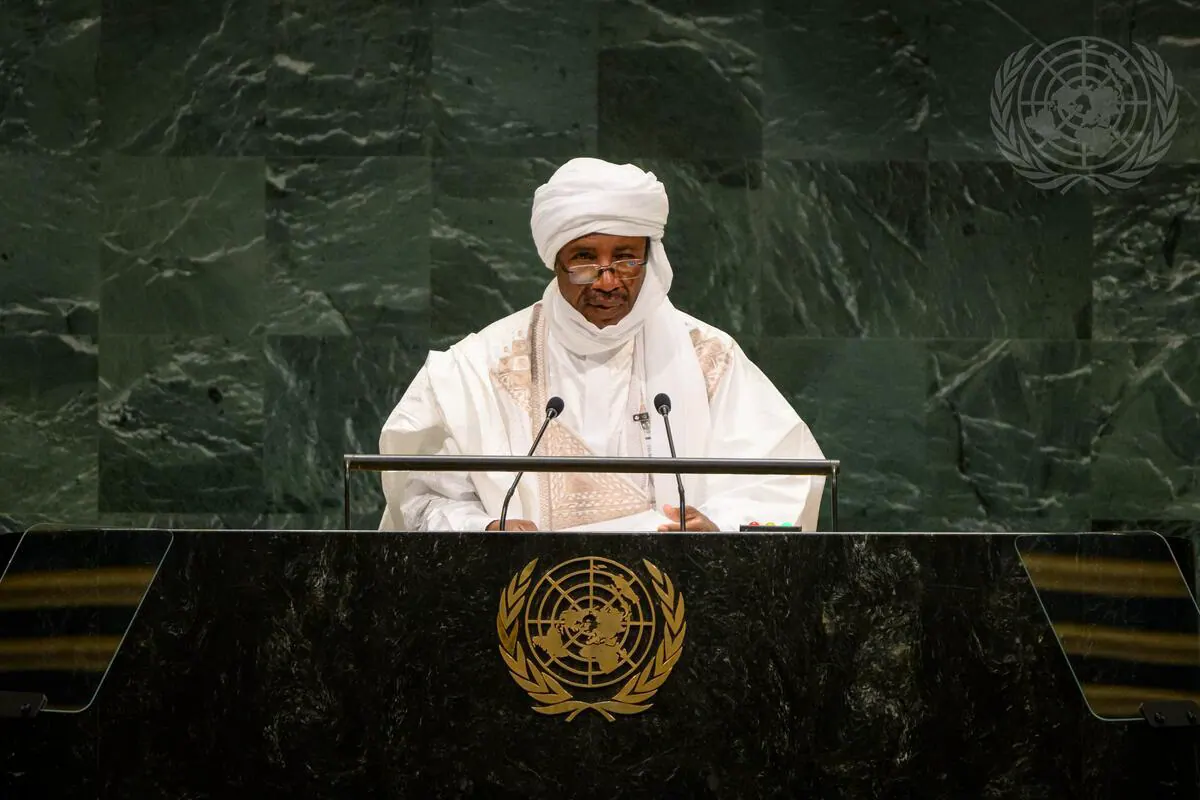
Chad's Minister of Public Health, Abdelmadjid Abderahim Mahamat, addressed the 81st session of the UN General Assembly, defending his country's decision to withdraw from the International Criminal Court (ICC). Mahamat stated that Chad's withdrawal from the ICC, announced on July 27, was not a renouncement of its responsibilities or a refuge from justice. Instead, the country aims to strengthen its national jurisdictions and support credible, independent, and effective African judicial mechanisms.
The Chadian representative justified his country's withdrawal by stating that the ICC's activities have long been focused on developing countries, particularly in Africa. Mahamat emphasized that Chad's decision does not imply a lack of commitment to justice, but rather a desire to reinforce its national judicial systems. He also expressed Chad's support for a reform of the UN Security Council, which has been discussed for several decades, but with limited progress.
The conflict in Sudan was a significant part of Mahamat's address. He stated that over a million Sudanese refugees have crossed into Chad since the start of the conflict in April 2023, and the country now hosts over two million forcibly displaced people. Chad has maintained a position of strict neutrality in the conflict, with Mahamat declaring that his country does not support either party and does not allow the use of its territory or infrastructure for their benefit.
Despite its neutrality, Chad has condemned recent airstrikes linked to the Sudan conflict that have hit its territory, describing them as an "inacceptable violation" of its territorial integrity. Mahamat warned that Chad reserves the right to take necessary measures, in accordance with international law, to protect its population and sovereignty if such incidents recur. The country's commitment to protecting its territory and people was emphasized in the face of ongoing regional instability.
On the security front, Chad has confirmed its decision to deploy 1,500 soldiers as part of a force tasked with combating gangs in Haiti, representing nearly a quarter of the total planned contingent. This move demonstrates Chad's commitment to international cooperation and peacekeeping efforts. Additionally, Mahamat reaffirmed Chad's support for the creation of a Palestinian state within the 1967 borders, alongside Israel, and called for peace and security for both states.
The Chadian representative also touched on the issue of multilateralism and the functioning of international institutions. He expressed Chad's attachment to the UN while calling for a more representative and effective organization. Mahamat concluded by stating that, despite disappointments, Chad remains committed to the force of law against the law of force.
In conclusion, Chad's participation in the UN General Assembly highlighted its commitment to defending its sovereignty and interests while engaging in international diplomacy. The country's stance on the ICC, Sudan conflict, and security cooperation reflects its strategic approach to regional and global issues. As Chad navigates complex international relationships, its dedication to multilateralism and peacekeeping remains a key aspect of its foreign policy.
Key points
- Chad defends its withdrawal from the ICC, citing the court's focus on African countries.
- Chad reaffirms its neutrality in the Sudan conflict and condemns recent airstrikes on its territory.
- Chad commits to deploying 1,500 soldiers to Haiti as part of a peacekeeping force.