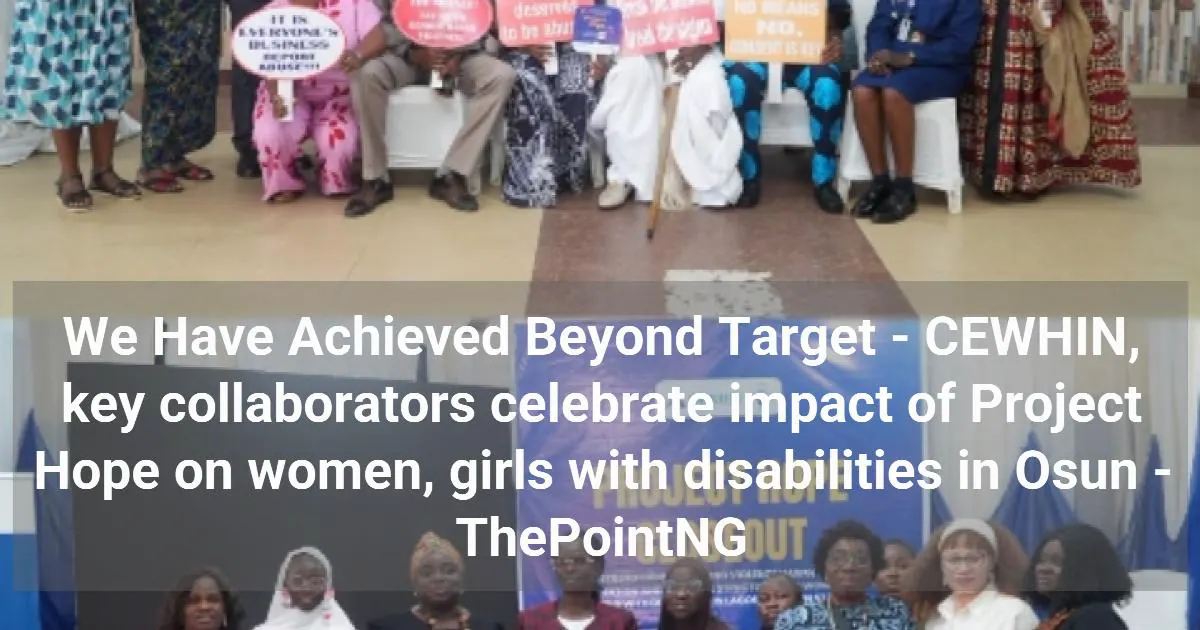
The Centre for Women’s Health and Information (CEWHIN) has marked the close-out of Project Hope, a three-year programme aimed at preventing and responding to gender-based violence against women and girls with disabilities in Osun State. The programme, supported by the UN Trust Fund to end violence against women (UNTF), brought together disability clusters, service providers, security agencies, government Ministries, Departments and Agencies, community leaders and civil society organisations.
Girls and women with disabilities in Osun State have shared emotional testimonies of transformation and empowerment, declaring that they have been empowered to know their rights and resist any form of abuse. The programme focused on strengthening existing systems of response in Osun and Lagos States, and stakeholders reflected on the achievements and lessons from Project HOPE. Collaborators pledged to sustain the tempo and ensure that the referral pathways already established are not abandoned.
The Executive Director of CEWHIN, Atinuke Odukoya, said the organisation achieved far beyond what it set out to achieve at the inception of the project. CEWHIN’s approach was anchored on collaboration and building on what already exists on ground, working with both actors already in the gender-based violence space and those who were not, but had the potential to become responders if their capacity was strengthened.
According to Odukoya, every organisation partnered under Project Hope has now integrated issues of women and girls with disabilities into its work, with some even writing dedicated proposals to sustain the intervention. The impact was particularly visible in the government sector, noting that several agencies that were previously not responding to women with disabilities are now doing so actively.
In Osun State, Project Hope was instrumental to the reopening and revitalisation of the Sexual Assault Referral Centre, SARC, as well as building the capacity of its staff and its steering committee comprising Ministries of Justice, Women Affairs and Health. The Community Task Force in Osun, made up of volunteers, has been responding to cases, writing reports and following up on abuses even without payment.
Odukoya highlighted the emergence of the Community Task Force in Osun, and the Deaf Associations in both Lagos and Osun stepping down trainings to their members and conducting community sensitization. Through the collaborative approach, the project was able to reach over one million people in three years. The School of Special Needs was also included, where young people were trained on psychosocial first aid and self-safeguarding.
On sustainability, Odukoya expressed confidence that the structures put in place will outlive the project. Partner organizations like CAI4SR already have ongoing programmes focusing on women and girls with disabilities as a direct fallout of Project Hope, while women’s economic empowerment groups now mandatorily include women and girls with disabilities in all their activities.
Key points
- The programme reached over one million people in three years through a collaborative, community-based approach.
- Project Hope led to the reopening of the Sexual Assault Referral Centre in Osun State and the emergence of the Community Task Force.
- The programme empowered women and girls with disabilities to know their rights and resist abuse.