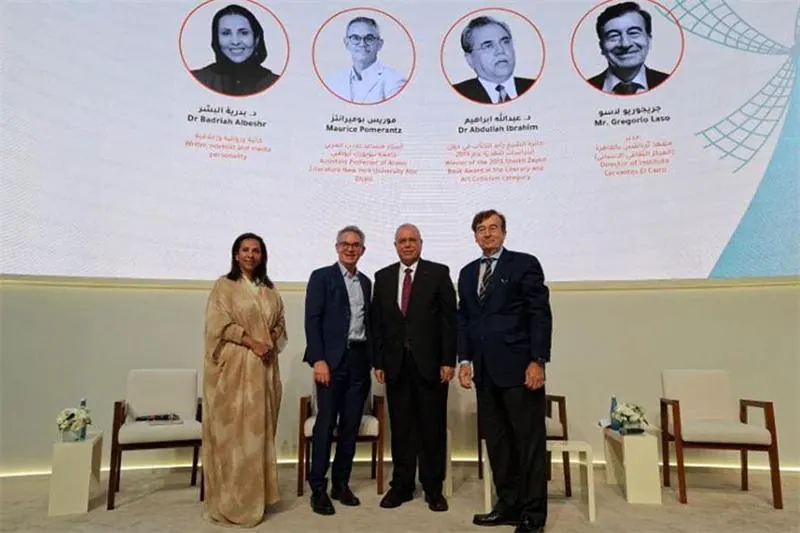
The 35th Abu Dhabi International Book Fair recently hosted a panel discussion on Miguel de Cervantes' Don Quixote, featuring Gregorio Laso, director of the Cervantes Institute in Cairo. The session, titled "Don Quixote Faces Reality on the Steed of Illusion," explored the novel's relationship between reality and imagination, as well as its enduring influence across cultures. The discussion was part of the fair's program, which included over 1,500 cultural events and 1,200 exhibitors from 95 countries.
Laso was appointed director of the Cervantes Institute in Cairo and Alexandria earlier this year, bringing extensive experience in international relations, media, and international affairs. He has held various diplomatic and media positions, including serving as media adviser at Spanish embassies in Russia, China, the United States, and Turkey. The panel discussion also featured Abdullah Ibrahim, winner of the Sheikh Zayed Book Award in Literature and Arts, and Maurice Pomerantz, associate professor of Arabic literature at New York University Abu Dhabi.
The session was moderated by writer, novelist, and media personality Badriah Albeshr, who guided the discussion on the interplay between reality and imagination in Don Quixote. The speakers examined how people perceive their reality and how literature and imagination can offer new ways of interpreting it. They also explored the novel's reception across different cultures and its movement between languages, with translations opening up new readings of its characters and ideas for audiences in diverse cultural contexts.
Don Quixote was selected as the "Book of the World" for the 2026 edition of the Abu Dhabi International Book Fair, reflecting its enduring place in Spanish and world literature. The novel has transcended the language in which it was written, influencing literature, theatre, cinema, and the visual arts, while its characters and themes have become part of the literary memory of cultures around the world. The selection highlights the novel's role in introducing Spanish language and culture to audiences worldwide.
The 2026 edition of the Abu Dhabi International Book Fair featured a diverse program, including over 1,500 cultural events and more than 380 figures from literature, thought, culture, and the arts. The fair selected the culture of the Balkans, in cooperation with North Macedonia, as its guest of honour, while highlighting the renowned Arab linguist Al-Khalil ibn Ahmad Al-Farahidi as its central figure. The event provided a platform for authors, thinkers, and cultural figures to share their ideas and engage with audiences.
The discussion on Don Quixote at the Abu Dhabi International Book Fair underscores the novel's continued relevance and influence across cultures. The panel brought together experts from different fields to explore the novel's themes and ideas, highlighting its enduring impact on literature and culture. The event also reflects the fair's commitment to promoting cultural exchange and understanding, bringing together people from diverse backgrounds to engage with literature and ideas.
The Cervantes Institute in Cairo, under the direction of Gregorio Laso, is likely to play a significant role in promoting Spanish language and culture in Egypt and the region. The institute's participation in the Abu Dhabi International Book Fair is part of its efforts to engage with cultural and literary communities in the region. The discussion on Don Quixote is a testament to the institute's commitment to promoting cultural exchange and understanding between Spain, Egypt, and the wider region.
Key points
- The Cervantes Institute in Cairo's director, Gregorio Laso, participated in a panel discussion on Don Quixote at the 35th Abu Dhabi International Book Fair.
- The discussion explored the novel's relationship between reality and imagination, as well as its enduring influence across cultures.
- Don Quixote was selected as the "Book of the World" for the 2026 edition of the Abu Dhabi International Book Fair, reflecting its enduring place in Spanish and world literature.