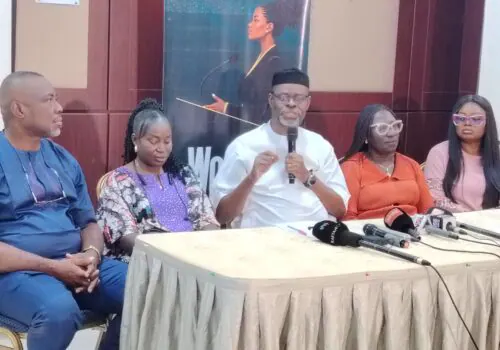
The African Centre for Leadership, Strategy and Development (Centre LSD) has urged the 10th National Assembly to pass the proposed Reserved Seats Bill for women, citing the need for constitutional intervention to address the persistent under-representation of women in Nigeria's political leadership. With less than nine months to the expiration of the 10th National Assembly, Centre LSD's Founding Executive Director, Dr. Otive Igbuzor, made the call in Abuja at a press conference.
Dr. Igbuzor argued that countries with significant female political participation have used constitutional and institutional mechanisms to address historical inequalities, resulting in better development outcomes. He noted that Nigeria remains one of the countries with very low representation of women in political institutions, despite women constituting about half of the population. The Centre LSD launched a new project, "Women Can Lead Project," to train, empower, and address challenges depriving most women from participating in governance and decision-making.
The proposed reserved or special seats arrangement is one of the measures that could provide women with greater access to legislative positions, according to Dr. Igbuzor. He urged the National Assembly to take responsibility for ensuring its passage, emphasizing that the 10th National Assembly has a historical responsibility to pass the Special Seats Bill to alter the trajectory of low female representation in Nigeria's parliament.
Dr. Igbuzor said the low number of women contesting elective positions should not be interpreted as a lack of interest or capacity among women but rather as a result of historical, economic, institutional, and socio-cultural barriers that have limited their participation. He cautioned against asking why women were not coming forward to contest presidential and governorship positions, saying such a question placed the burden on women instead of addressing the structures that make political participation difficult for them.
The Centre called on government institutions at all levels to mainstream gender into policies, programmes, plans, and budgets to create opportunities for women inclusion in governance and decision-making across the country. It also challenged traditional and religious leaders to use their considerable influence to challenge harmful norms and practices and promote dignity and equality.
The "Women Can Lead Project" is a 24-month initiative of Centre LSD, supported by the Ford Foundation, with a geographic focus on Benue state, Kano state, and the Federal Capital Territory (FCT). The project aims to create stronger platforms and enabling conditions for women to participate, lead, and influence decisions in governance and public life.
Dr. Igbuzor emphasized that the burden of achieving gender equality cannot be placed on women alone, requiring engagement with government institutions, political and community structures, traditional institutions, faith communities, civil society organisations, men, and other holders of influence to examine the rules, systems, practices, and norms that determine who gets in, who is heard, who exercises influence, and who makes decisions.
Key points
- The African Centre for Leadership, Strategy and Development urges the 10th National Assembly to pass the Reserved Seats Bill for women.
- The Centre LSD launches the "Women Can Lead Project" to train, empower, and address challenges depriving most women from participating in governance and decision-making.
- The proposed reserved seats arrangement aims to provide women with greater access to legislative positions.