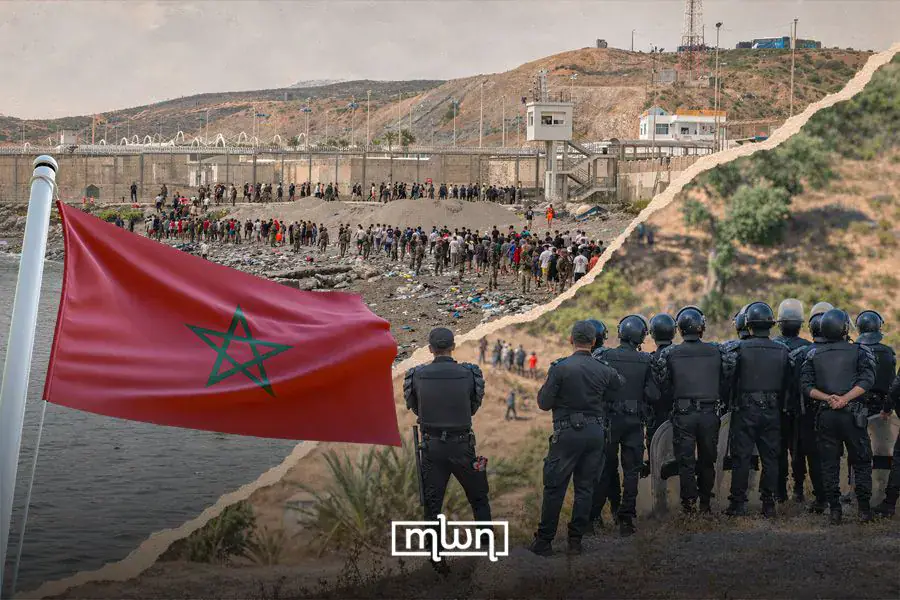
The National Centre for Immigration and Borders (CENIF) has accused Morocco of planning and orchestrating the mass entry of migrants into Ceuta in late July. However, reports from Spain's National Intelligence Center (CNI) contradict this claim, finding no evidence to suggest Moroccan involvement. The CNI's declassified documents, handed over to Judge Tardón, reveal that Moroccan security officers were cooperative, although overwhelmed by the high number of rescue operations.
CENIF claims to have identified 18 senior Moroccan civilian and police officials, whom it describes as "facilitators," who were present during the mass entry. CENIF presented names, official positions, and photographs of these officials, along with their responsibilities and actions during the crisis. However, this evidence only proves that Moroccan authorities were present and attempting to manage the situation, not that they orchestrated it.
The presence of senior Moroccan Interior Ministry and National Police officials on the ground was a natural response to the crisis, as they worked to maintain public order and prevent security forces from being overwhelmed. CENIF has chosen to interpret this as evidence of Morocco's alleged plot, despite the lack of concrete evidence. The photographs supplied by CENIF show Moroccan officials coordinating their activities, but this does not establish their intentions.
CNI reports, including one drafted on July 30, describe Moroccan security officers as "reasonably cooperative, although overwhelmed." The reports highlight Morocco's efforts to prevent migrants from entering Ceuta and its agreement to take back migrants who had crossed into the city. This contradicts CENIF's narrative that Morocco planned and orchestrated the mass entry.
Intercepted telephone conversations, as reported by the CNI, capture a senior Moroccan police commander ordering officers to stay on alert and not leave their post. These conversations also reveal the Royal Moroccan Navy's efforts to remove or puncture flotation devices in the border area to prevent migrants from reaching Ceuta. These actions undermine CENIF's claim that Morocco facilitated the mass entry.
The CNI's findings have further weakened CENIF's narrative. A report submitted by the CNI on November 11 states that its database information does not match the facial recognition of the biometric data of the alleged gendarmes and plainclothes officers identified in CENIF's first report. This new evidence dismantles the narrative that CENIF has promoted for weeks.
The differing accounts from CENIF and CNI have significant implications for the relationship between Morocco and Spain. While CENIF's accusations against Morocco remain unsubstantiated, the CNI's reports suggest that Morocco acted to mitigate the crisis, not create it. The Spanish government's declassification of CNI reports has shed light on the events surrounding the Ceuta migrant crisis, revealing a more nuanced reality.
Key points
- CENIF's accusations against Morocco lack concrete evidence.
- CNI reports contradict CENIF's narrative, suggesting Morocco acted to mitigate the crisis.
- The differing accounts have significant implications for Morocco-Spain relations.
Reporting sources
- Ceuta: CENIF Accuses Morocco While the CNI Points in a Different Direction · Morocco World News