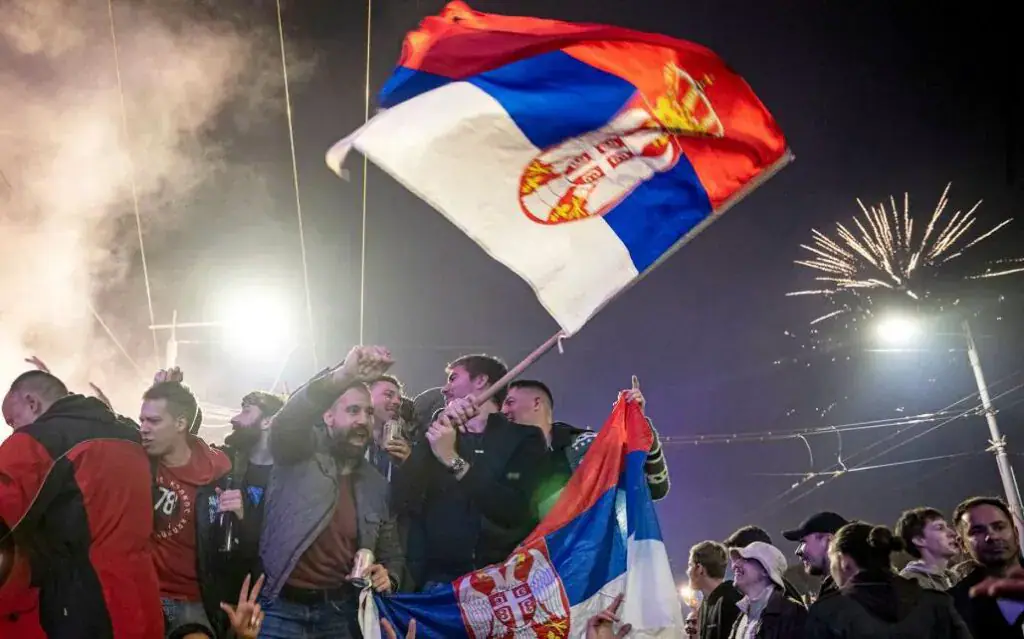
Celebrations broke out across Serbia on Monday as a student-led protest movement won the parliamentary elections, defeating the country's long-standing leader Aleksandar Vučić and his Serbian Progressive Party (SNS). With 97% of polling stations counted, the student movement, known as the Student List, secured 52.7% of the vote, while Vučić's SNS party garnered 39.2%. The Student List's victory marked a significant shift in Serbia's politics, with the movement's lead candidate, Ilija Srdanović, vowing to "free the country from tyranny".
The student movement was formed less than two years ago in response to a railway station disaster that killed 16 people and was blamed on corruption and negligence. The movement's candidates, who were drawn from across Serbian society, including doctors, actors, academics, and sports personalities, ran on a manifesto that included purging officials who broke rules, cracking down on protesters, and freeing the public broadcaster from political control. The Student List's victory was met with jubilation on the streets of Belgrade, Novi Sad, and other cities, with people dancing, chanting "victory", and setting off fireworks.
Vučić, who had spent two terms as president and could not seek a third term, had aimed to return to the post of prime minister by leading his SNS party in the election. However, he conceded defeat on Monday, saying "it is clear we have lost these elections". The SNS party had been in power since 2012, and Vučić's defeat marked a significant end to his era of dominance in Serbian politics. The Student List's victory was welcomed by Hungary's prime minister, Péter Magyar, who said he was delighted to hear from the movement's leaders about the strength they had gained from Magyar's own recent electoral victory.
The election was held amid high tensions across Serbia, with police sealing off streets around the Republic Electoral Commission in Belgrade. Long queues were seen outside polling stations in cities and towns across Serbia, as well as in countries with sizeable Serbian communities, including Slovenia, Germany, and the US. The election result marked a new chapter for Serbia, with European Commissioner for Enlargement Marta Kos saying the door to the EU was open and ready to move forward with the country.
Attention now turns to who will lead the Student List as prime minister, with presidential elections due to take place in December. The current parliament speaker, Ana Brnabić, is filling the role of president in a caretaker capacity. The Student List's victory has been hailed as a significant moment for democracy in Serbia, with Professor of Political Science Nebojša Vladisavljević saying the movement had "absolute legitimacy" to govern for the coming years.
The Kremlin has issued a statement on Vučić's defeat, with spokesperson Dmitry Peskov praising Vučić's contribution to relations with Russia and hoping the new government in Belgrade would understand the importance of co-operation with Moscow. The Student List's victory has also been seen as a significant moment for the European Union, with Kos saying a new chapter could begin for Serbia's relations with the EU.
As Serbia looks to the future, the Student List's lead candidate, Ilija Srdanović, has vowed to work towards a "free state". With the movement's commitment to tackling corruption and promoting democracy, many are optimistic about the country's prospects for reform and progress. Key to this will be the movement's ability to work with different groups and interests in Serbian society, and to deliver on its campaign promises.
Key points
- The student-led movement won 52.7% of the vote, defeating Vučić's SNS party which secured 39.2%.
- The election result marks a significant shift in Serbia's politics, ending Vučić's dominance since 2012.
- The Student List's victory has been welcomed by European leaders, who see it as an opportunity for Serbia to move closer to the EU.