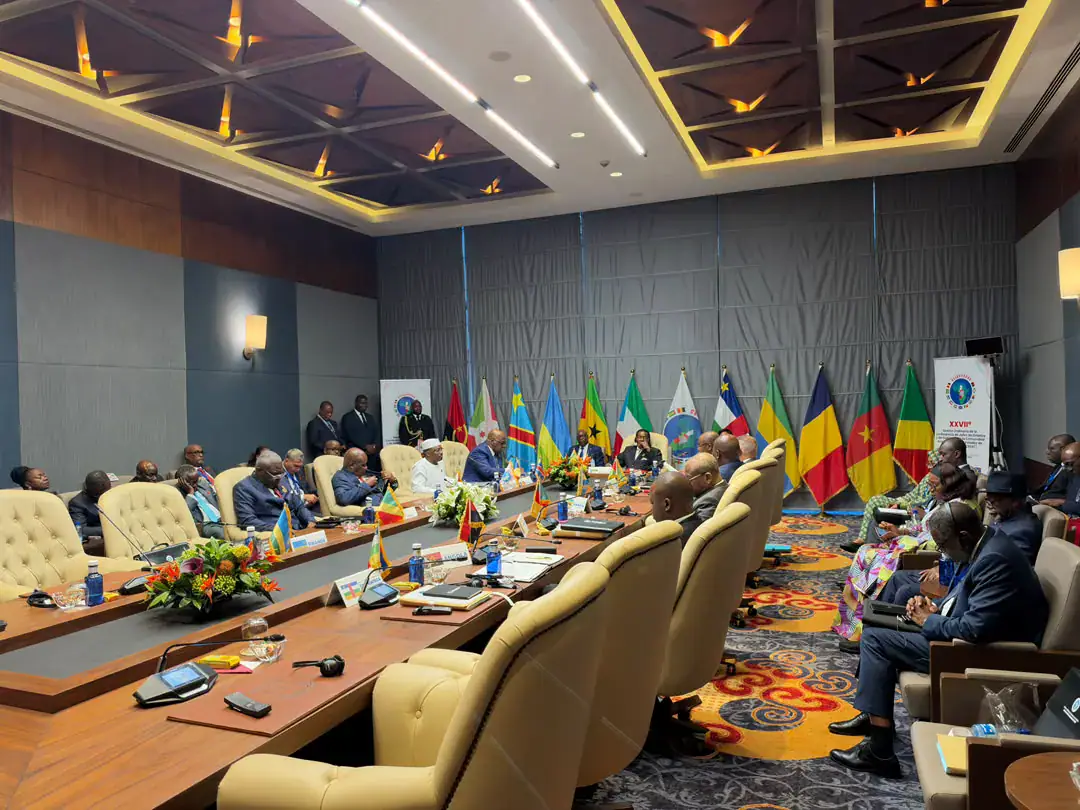
The 27th ordinary session of the Conference of Heads of State and Government of the Economic Community of Central African States (CEEAC) took place on November 27, 2026, in Sipopo, Equatorial Guinea. Under the chairmanship of Equatorial Guinea's President Obiang Nguema Mbasogo, the session brought together leaders from CEEAC member states to discuss regional integration, security, economic cooperation, and humanitarian challenges. The meeting was held under the theme "Accelerating Regional Integration in Central Africa for the Benefit of the Region's Peoples."
One of the key issues addressed was the need to make the free movement of persons, goods, and services within the community a reality. The heads of state called for the gradual lifting of administrative and operational obstacles that still hinder this mobility. They also emphasized the development of transport and interconnection infrastructure, harmonization of economic and social policies, and promotion of trade exchanges between member states.
The conference instructed the CEEAC Commission to conduct a regional inventory of manufactured products and high-potential sectors to enhance their competitiveness and integration into regional value chains. On security, the leaders expressed concern over the persistent insecurity and its humanitarian consequences in eastern Democratic Republic of Congo (DRC). They called for continued efforts to de-escalate the situation and respect commitments made within regional and international peace mechanisms.
The humanitarian situation in Chad was also discussed, with the conference noting that the country currently hosts over two million refugees and internally displaced persons. This is largely due to the conflict in Sudan, security challenges in the Lake Chad region, and the effects of climate change. The heads of state appealed for solidarity from member states and the international community to provide political, technical, and financial support to Chad.
Several important decisions were adopted during the conference, including the CEEAC Vision 2050 and the 2026-2030 Indicative Strategic Plan. Other decisions concerned integrated border governance, maritime security, electricity regulation, and the organization of the Central African Health Organization. Chad was also designated to take over the community's leadership, with Mahamat Idriss Déby Itno succeeding Obiang Nguema Mbasogo as the new chair.
The conference also paid tribute to President Obiang Nguema Mbasogo for his contribution to consolidating community action and expressed support for President Déby Itno in pursuing regional integration and shared prosperity objectives. The handover ceremony saw the symbolic transfer of the community flag from the outgoing to the incoming chair. The next CEEAC session is scheduled for February 2027 in N'Djamena, Chad.
The 27th CEEAC session demonstrated a renewed commitment to regional integration and cooperation among member states. The outcomes of the meeting are expected to have a positive impact on the lives of citizens in the region, promoting economic growth, stability, and prosperity. The CEEAC leaders' emphasis on free movement and infrastructure development is seen as a crucial step towards achieving these goals.
Key points
- CEEAC leaders emphasize need for free movement of persons and goods
- Chad designated to take over CEEAC leadership
- Next CEEAC session scheduled for February 2027 in N'Djamena, Chad