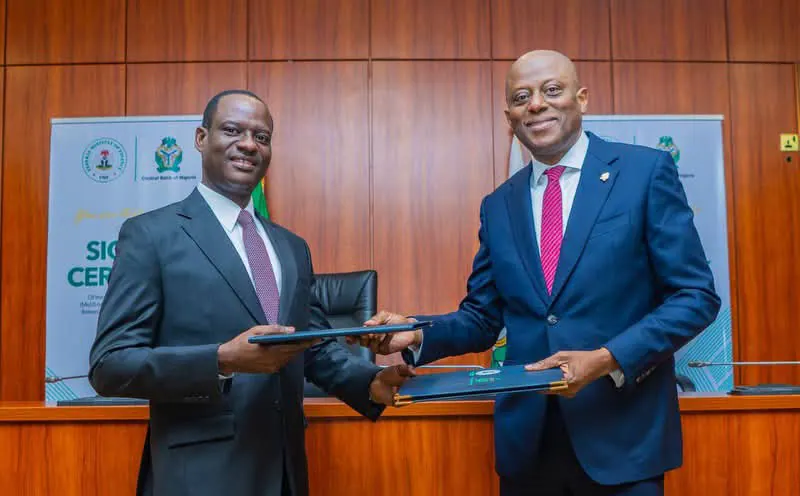
The Central Bank of Nigeria (CBN) and the Federal Ministry of Finance have signed a Memorandum of Understanding (MoU) to institutionalise coordination between Nigeria's fiscal and monetary authorities. The agreement, signed on September 18, 2026, aims to strengthen macroeconomic management and support Nigeria's transition to an inflation-targeting framework. The MoU was signed by CBN Governor, Olayemi Cardoso, and Minister of Finance and Coordinating Minister of the Economy, Professor Taiwo Oyedele.
The MoU establishes a structured system for regular consultation, information sharing, and policy coordination between the CBN and the finance ministry. Areas of focus will include government cash management, debt issuance planning, liquidity forecasting, and macroeconomic analysis. According to Cardoso, the framework is designed to convert an informal working relationship into one built on defined processes and institutional commitments, reducing uncertainty and improving the quality of economic decision-making.
Cardoso linked the timing of the agreement to the CBN's ongoing shift toward an inflation-targeting monetary policy framework. He noted that internationally, the success of such frameworks depends heavily on the presence of a supportive fiscal environment. The MoU will serve as the basis for developing a more detailed operational framework to guide implementation going forward.
Oyedele framed the agreement around the idea that Nigeria's fiscal and monetary authorities, despite having separate mandates, are ultimately managing a single economy. He noted that government borrowing decisions affect liquidity and interest rates, and that monetary policy in turn affects the government's own cost of financing. Oyedele stressed that the MoU does not create coordination mechanisms from a blank slate, but rather builds on existing structures.
Oyedele and Cardoso emphasised that the operational independence of the CBN remains untouchable, and that coordination must not be allowed to tip into fiscal dominance over monetary policy. The CBN will retain full autonomy in pursuing price and financial-system stability, while the government strengthens fiscal governance institutions. Oyedele stated that bringing inflation sustainably into single digits cannot rest on monetary policy alone, and that fiscal policy has its own role to play.
Oyedele highlighted the importance of addressing structural drivers of inflation, such as food costs, imported input costs, energy, and logistics. He called for stronger grain reserves, improved seed varieties and crop yields, expanded irrigation, and better rural road infrastructure to prevent produce from becoming unaffordable. The minister also emphasised the need for collaboration with state governments to address issues such as unnecessary road levies and farm-access infrastructure.
Both officials emphasised the importance of improved data quality as monetary policy shifts toward an inflation-targeting model. Oyedele said the Ministry is working with the National Bureau of Statistics to expand the range of economic indicators available to policymakers. The Ministry and the CBN will also begin sharing data more efficiently on cash positions, financing plans, credit growth, and foreign exchange flows.
Key points
- The MoU aims to strengthen macroeconomic management and support Nigeria's transition to an inflation-targeting framework.
- The agreement establishes a structured system for regular consultation, information sharing, and policy coordination between the CBN and the finance ministry.
- The MoU builds on existing structures, including the Economic Management Team and the National Economic Council, to make coordination more deliberate and effective.