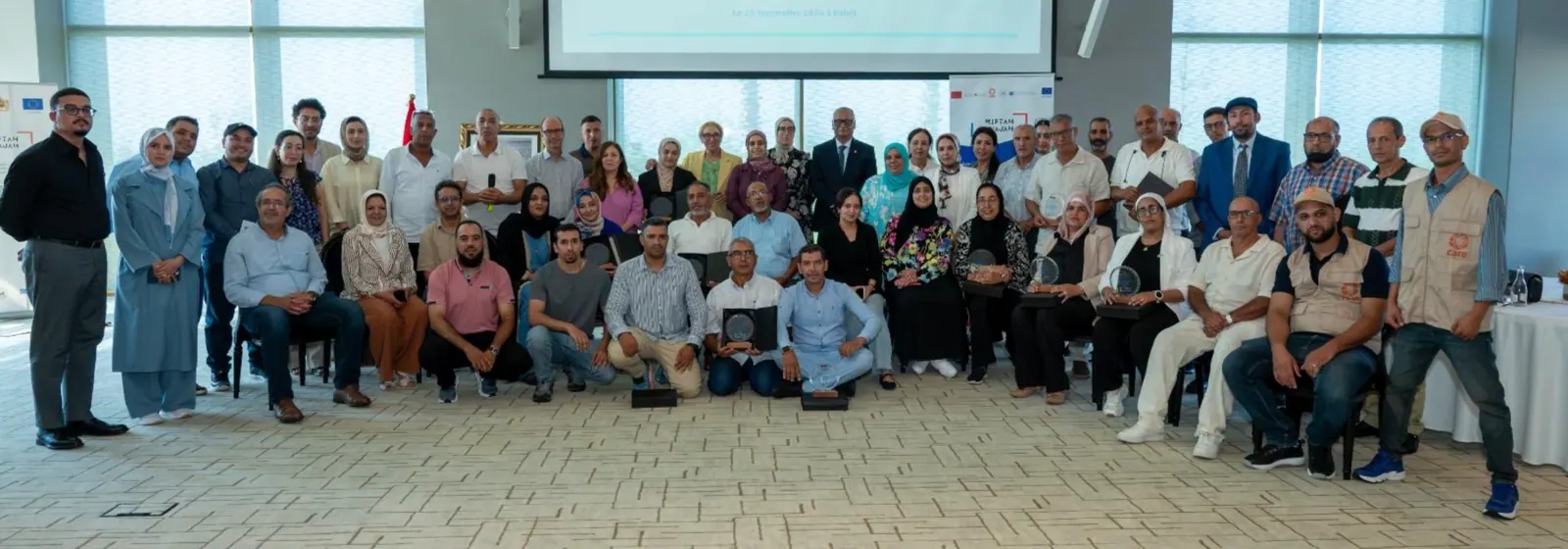
CARE Maroc recently presented the evaluation of its Miftah Anajah project in Rabat, Morocco. The project, which ran for 39 months, was implemented in partnership with the National Federation of Parents' Associations in Morocco (FNAPEM) and the Rabat Social Studies Institute (RSSI). It aimed to support education and training in the Marrakech-Safi and Béni Mellal-Khénifra regions. The project was part of a larger program, PIAFE, which seeks to promote relevant models for education and vocational training.
The Miftah Anajah project was launched in May 2023 and benefited 41,761 students in the Marrakech-Safi and Béni Mellal-Khénifra regions. The project supported 19 educational and pedagogical initiatives with a total budget of 1.65 million Moroccan dirhams (MDH). It also provided training for 620 teachers and educators. Additionally, 354 mothers received coaching to enhance their leadership and participation in school life.
The project was implemented in line with the vision of the Regional Education and Training Academies (AREF) of Marrakech-Safi and Béni Mellal-Khénifra. It was also supported by the provincial education authorities in Marrakech and Khénifra. The project's success was attributed to its inclusive approach, which involved schools, families, and local stakeholders. Hlima Razkaoui, director of CARE Maroc, highlighted the importance of building trust between schools, families, and local actors.
Razkaoui emphasized that the project's closure marks a new stage in its development. CARE Maroc aims to ensure that the project's achievements continue to inspire other initiatives in favor of inclusive and quality education. The project's success was also attributed to its ability to empower parents' associations and local stakeholders to take ownership of educational initiatives.
Noureddine Akouri, president of FNAPEM, praised the project's approach, which involved associating directors, teachers, and parents' associations in the design and implementation of school projects. Akouri highlighted the project's potential to create sustainable impact by encouraging inclusive participation and promoting long-term commitment.
The project mobilized 36 associations of mothers, fathers, and student guardians, as well as 51 associations supporting school success. It also led to the creation of 30 multi-stakeholder coordination spaces within schools. These spaces facilitated collaboration and coordination among various stakeholders, including teachers, parents, and local authorities.
The evaluation of the Miftah Anajah project highlights its achievements and impact on education and training in Morocco. The project's success demonstrates the potential of collaborative approaches to promoting inclusive and quality education. CARE Maroc and its partners aim to build on the project's achievements and continue to support educational initiatives in Morocco.
Key points
- CARE Maroc evaluates Miftah Anajah project, supporting education and training in Morocco
- Project empowered parents' associations and local stakeholders to take ownership of educational initiatives
- Project promoted inclusive participation and created sustainable impact in education sector