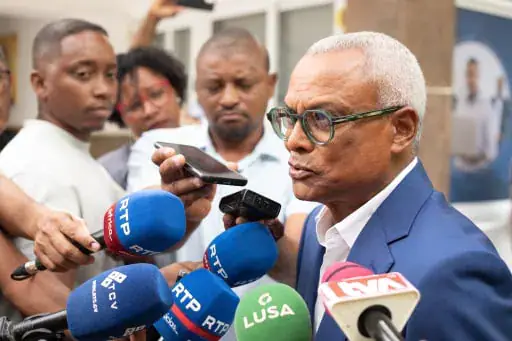
Cape Verde's President Jose Maria Neves has been re-elected, securing 63.8% of the votes in the recent presidential election. As the incumbent president and favourite to win, Neves' victory was largely expected. The election, which took place on Sunday, was observed by nearly 150 international observers from the Economic Community of West African States, the African Union, and the European Union.
The West African archipelago, comprising 10 volcanic islands located 600 kilometres off the coast of Senegal, is known for its stable democracy and good governance. With a population of nearly 420,000 eligible voters, the country's electoral commission reported a smooth voting process. Neves faced several contenders, including Joana Rosa Amado, the country's first woman candidate.
Cape Verde has been recognised as a model of democracy in Africa, with strong economic growth and a high ranking in the Mo Ibrahim Foundation's 2026 index on global governance. The country ranks third out of 54 countries on the continent. Its semi-presidential system, where the executive is dominated by the prime minister, contributes to its stability.
President Neves, who was first elected in 2021, has a long history of public service. He served as prime minister and president of the African Party for the Independence of Cape Verde (PAICV) from 2001 to 2016. Neves also has experience as a mayor and lawmaker. His re-election was supported by the PAICV, which won legislative elections in May.
The World Bank recently classified Cape Verde as an upper-middle-income country, driven by economic growth in the tourism sector. However, the country still faces significant challenges, including social inequality, geographic isolation, and high living costs. The increased cost of living, fuel prices, and youth unemployment are major concerns for the population.
Neves' re-election campaign focused on his ability to inspire Cape Verdeans and provide stability in times of international uncertainty. His supporters argue that his experience and patriotism make him the ideal candidate to lead the country. The president's role in Cape Verde is largely symbolic, with the prime minister holding executive power.
As Cape Verde continues to develop its tourism industry and address social and economic challenges, President Neves' re-election is expected to maintain the country's stability and democratic trajectory. The international community has taken note of Cape Verde's progress, with the country's unique culture, known as "morabeza" or hospitality, and its vibrant music and carnival celebrations.
Key points
- President Jose Maria Neves secured 63.8% of votes in the presidential election.
- Cape Verde is considered a model of democracy in Africa, ranking third in the Mo Ibrahim Foundation's 2026 index on global governance.
- The country faces challenges such as social inequality, geographic isolation, and high living costs, despite being classified as an upper-middle-income country by the World Bank.
Reporting sources
- Cape Verde's President Jo... · ModernGhana