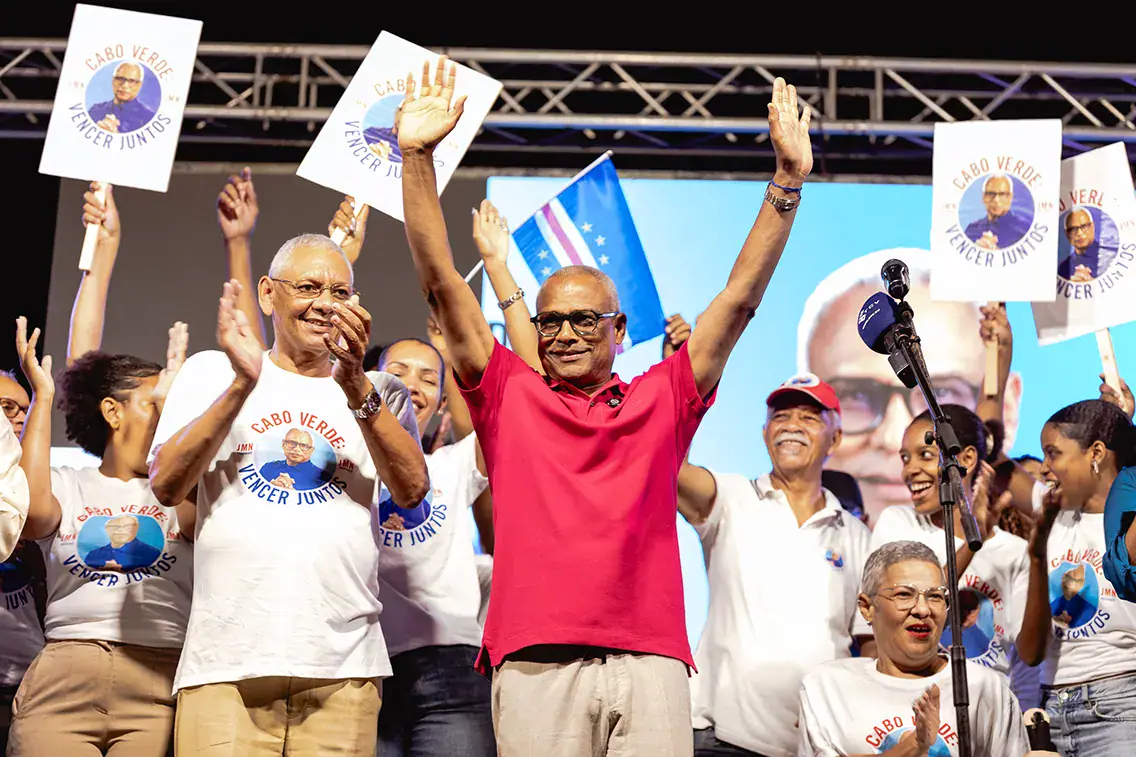
Cape Verde President José Maria Neves has been reelected for a second term, securing 63.8% of the vote in the November 15th, 2026 elections. Neves declared victory in a televised address, stating his closest challenger, former Justice Minister Joana Rosa, had conceded and congratulated him. He emphasized his commitment to being an independent and impartial president, serving as an arbiter and moderator of the political system. Neves' campaign focused on continuity, particularly in economic growth and protecting the diaspora.
The preliminary results show Neves' main opponent, Joana Rosa, secured 31.6% of the vote, making her the country's first female presidential candidate. Other candidates, including Antero Tavares, Casimiro de Pina, Gilson Alves, and Loisito Sousa, also participated in the election. Neves previously won the presidency in 2021 with 52% of the vote. His reelection gives his party, the Partido Africano da Independência de Cabo Verde (PAICV), control of both the presidency and the premiership for the first time in over a decade.
The 10-island archipelago has a hybrid presidential and parliamentary system, which has contributed to its stability. According to the Mo Ibrahim Governance Index, Cape Verde ranked third out of 54 countries in 2025, after Seychelles and Mauritius. This ranking reflects the country's effective governance and stability. Neves has been a key figure in Cape Verde's politics, serving as Prime Minister for 15 consecutive years until 2016.
Despite his reelection, the election saw a low turnout, estimated at about a third of the eligible votes. Over 420,000 people were eligible to vote, but many did not participate. Neves and pundits attribute the low turnout to the country's high emigration rate, population shifts, and outdated records. The high emigration rate and economic growth were significant issues in the 2026 elections, with candidates proposing plans to address these challenges.
Neves' campaign also focused on addressing emigration, promising to organize a dedicated youth summit to tackle the issue if reelected. Cape Verde has a large diaspora, with more citizens living abroad, mainly in the USA and Portugal, than at home. The country's economic growth and diaspora protection were key themes in the election.
The PAICV's victory in the parliamentary elections in May 2026, led to Francisco Avelino Vieira de Carvalho, the former Mayor of Praia, being appointed Prime Minister. Neves' reelection marks the beginning of the end of his long political career, as this will be his second and final term. Born in 1960, Neves has been a member of the PAICV since the 1980s.
Neves' second term is expected to focus on consolidating his party's control and addressing the country's challenges. His commitment to continuity and stability is likely to shape his future policy initiatives. As the country moves forward, Neves will need to address the issues of emigration and economic growth, which were central to his campaign.
Key points
- Neves secured 63.8% of the vote in the November 15th, 2026 elections.
- The election saw a low turnout, estimated at about a third of the eligible votes.
- Neves' reelection gives his party, the PAICV, control of both the presidency and the premiership for the first time in over a decade.