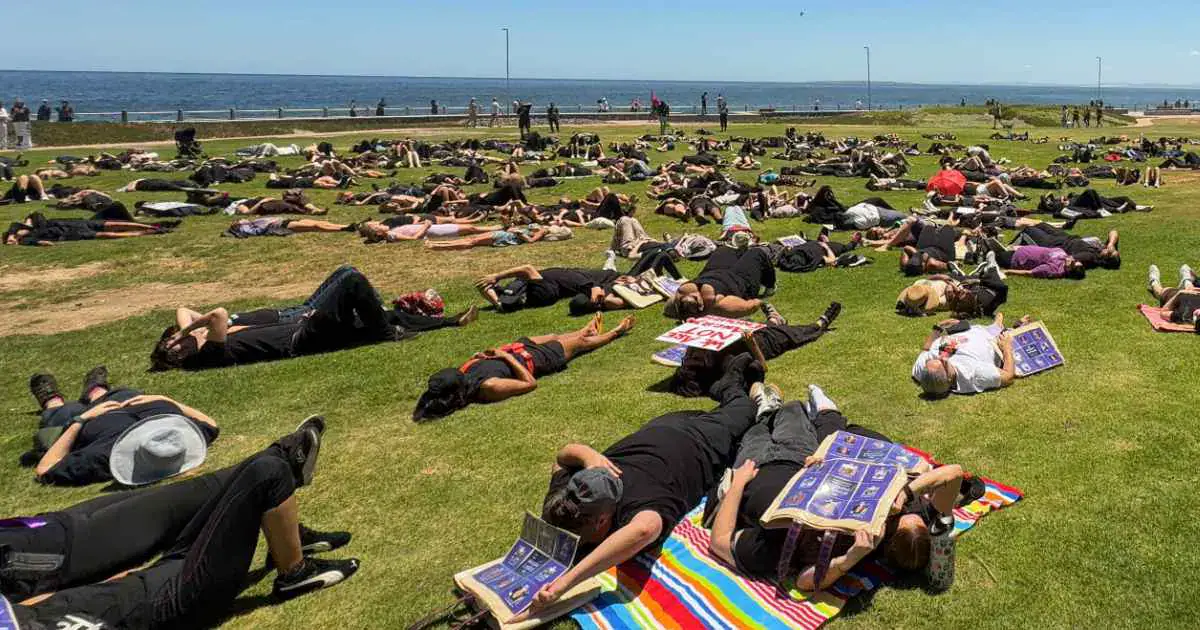
On November 21, Cape Town's Sea Point Promenade was the site of a powerful demonstration against gender-based violence and femicide. At 12 noon, women and supporters lay down for 15 minutes, symbolizing the estimated 15 women murdered every day in South Africa. This action was part of the national Women's Shutdown, organized by Women For Change, which called on women, LGBTQIA+ people, and allies to stand together against violence.
The event in Cape Town was part of a larger national movement, with the main action taking place at Constitution Hill in Johannesburg. Coordinator Ra Searll described the Cape Town turnout as encouraging, particularly following recent public outcry over the murder of women in Kempton Park, Ekurhuleni. Searll noted that despite the expected rise and fall in collective action, the turnout was impressive, with many people coming out to show their support.
However, activists stressed that public mobilization must be matched by effective action from government and other institutions. Fellow coordinator Neo Makhuran emphasized that despite government promises, women continue to be targeted across the country. Makhuran noted that even a year after GBV was declared a national disaster, the number of women murdered every day has not dropped, remaining at 15 women per day.
The campaign's message also found expression through public art. At Rocklands Beach, Public Art Cape Town (PACT), in collaboration with Women For Change and supported by Duram, invited community members to contribute to a new mural against GBV and femicide. PACT founder Shani Judes explained that the mural drew inspiration from the organization's Unburied Caskets artwork, incorporating 5,578 bees representing women murdered in South Africa in the previous year.
The gathering also carried a message of dignity, bodily autonomy, and remembrance. One statement captured the demand at the heart of the protest: "We are asking to live. We are asking to control our own bodies. We are asking for NO to be NO. We are asking for opportunity." Activists highlighted that the fight against GBV must also recognize violence shaped by homophobia and transphobia.
Lesbian, bisexual, and queer women, transgender people, and gender-diverse people should be included and represented in prevention efforts, survivor support, and access to justice. Searll emphasized that the movement would continue to take a stand for survivors and families until all women and children were protected. The movement's goal is to ensure that women and children are protected in South Africa.
The message from Cape Town was clear: remembrance and solidarity matter, but they must be accompanied by accountability, protection, and measurable change. The activists and supporters who gathered at the Sea Point Promenade and other locations across the country made it clear that they will continue to push for change until tangible results are achieved.
Key points
- The national Women's Shutdown aimed to bring attention to the ongoing issue of gender-based violence and femicide in South Africa.
- Activists emphasized the need for effective action from government and institutions to address the issue.
- The movement seeks to ensure that all women and children, including those from marginalized communities, are protected and included in prevention efforts and access to justice.