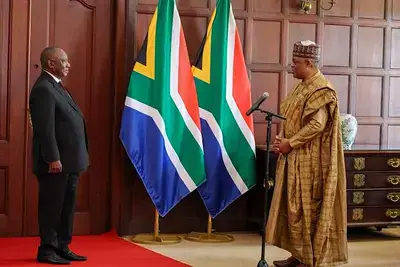
Nigeria's High Commissioner to South Africa, Femi Fani-Kayode, has arrived in Pretoria with a contentious claim that Nigeria contributed $61 billion to South Africa's liberation. This figure has been invoked in speeches since presenting his credentials, implying that Nigeria's contribution sets it apart from other African nations that made similar sacrifices. However, the accuracy of this number has been disputed, and its origin has been traced to a single sentence in a 2010 SAIIA opinion piece by Dr. Nomfundo Xenia Ngwenya.
The $61 billion figure is an estimate that spans over three decades, bundling forgone oil revenue, regional aid to Frontline States, subventions to liberation movements, scholarships, hosting of exiles, and diplomatic costs. Roughly two-thirds of this amount is opportunity cost, or revenue Nigeria never earned, rather than cash disbursed. Presenting it as money given directly to South Africa's struggle has been criticized as a category error. The ISS Africa noted in 2015 that the number was widely circulated but unverified, and fact-checkers have since confirmed its origin while cautioning against treating it as fact.
The use of this unverified estimate by Fani-Kayode has been seen as an attempt to convert it into a hierarchy of sacrifice among nations that contributed to South Africa's liberation. However, this claim collapses under scrutiny, as Tanzania, Zambia, Mozambique, Angola, Zimbabwe, and Botswana also bore significant costs in their fight against apartheid. The struggle was continental, and the liberation of South Africa was achieved through a coalition of states and peoples, not through one nation's financial contribution.
Questions have been raised about how much of Nigeria's aggregate contribution actually reached liberation movements as usable resources. While Nigeria's solidarity with the anti-apartheid movement is not in question, its description must be honest and accurate. The accurate formulation of Nigeria's contribution is that it has been estimated at approximately $61 billion between 1960 and 1994, much of it forgone oil revenue and regional aid.
The controversy surrounding the $61 billion claim has strained relations between South Africa and Nigeria. South African officials have acknowledged Nigeria's historic support but have not endorsed the $61 billion number. A diplomat who treats an unaudited estimate as a diplomatic asset is not resetting relations but rather inflaming them.
Dr. Lehlohonolo Gabriel Mambona, an Implementation Systems Architect and Public Economics Commentator, has criticized Fani-Kayode's use of the $61 billion figure. Mambona argues that the figure is not a fact-based cash transfer and does not establish a hierarchy of sacrifice among nations that contributed to South Africa's liberation. He emphasizes that Nigeria's record in the struggle against apartheid is honourable and does not require inflation or inaccuracy.
The dispute highlights the need for credibility in diplomatic relations. A substantive diplomatic response requires accurate and verifiable information. The use of unverified estimates can undermine trust and hinder constructive dialogue. As tensions between South Africa and Nigeria continue, it is essential to prioritize accuracy and honesty in describing their respective contributions to the anti-apartheid movement.
Key points
- The $61 billion figure cited by Nigeria's High Commissioner to South Africa is an unaudited estimate with no breakdown or citation.
- The figure bundles forgone oil revenue, regional aid, and other forms of support over three decades, making it difficult to verify.
- The controversy has strained relations between South Africa and Nigeria, highlighting the need for accurate and verifiable information in diplomatic relations.
Reporting sources
- The $61 Billion Myth · Mail & Guardian