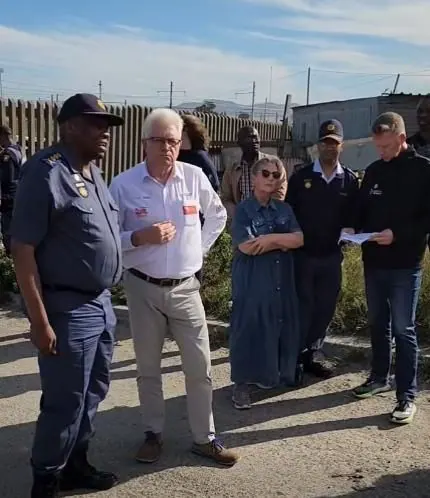
Law enforcement leaders in Cape Town, South Africa, have identified illegal land occupation as a primary driver of the city's crime crisis. City of Cape Town Mayoral Committee member for Safety and Security, JP Smith, made the statement during a recent inspection of informal settlements in Nyanga and Philippi. The inspection was conducted alongside the South African Police Service and LEAP officers. The areas inspected included informal structures built on railway tracks owned by PRASA.
According to Smith, the collaboration between law enforcement agencies is yielding positive results. He stated that there are now seventy areas where LEAP officers are deployed in significant numbers, making a positive impact when working alongside the South African Police Service. Data shows a 12.7 percent reduction in the murder rate in Nyanga over the last few years. However, Smith emphasized that visible policing alone has its limits and that crime intelligence is crucial in addressing extortion syndicates and mass killings.
Western Cape police Provincial Commissioner Lieutenant-General Sizakhele Dyantyi pointed out that illegal land occupation is a root cause of criminal activity. Smith highlighted that such occupations create an environment that is difficult to police. The presence of informal structures on railway tracks in Philippi, built on PRASA land, is cited as an example. This situation hampers the ability of law enforcement to effectively patrol and control crime.
The City of Cape Town and the Western Cape Government plan to push for amendments to the Prevention of Illegal Eviction from and Unlawful Occupation of Land Act (PIE Act). The PIE Act, enacted in 1998, aims to prevent arbitrary evictions and establish fair procedures for removing unlawful occupiers. However, officials argue that the current legislation lacks teeth, making it challenging for landowners to protect their property.
Smith noted that previous attempts to amend the PIE Act were unsuccessful. The proposed changes currently under consideration are described as "somewhat watered down" and may not provide the necessary relief. The issue of illegal land invasions is said to be at the core of many high-crime areas in Cape Town.
The recent inspection and statements from officials underscore the complexities of addressing crime in Cape Town. The combination of illegal land occupation, extortion syndicates, and the availability of illegal firearms fuel the city's criminal economy. Addressing these issues requires a multi-faceted approach that includes legislative reform and enhanced law enforcement strategies.
The collaboration between the City of Cape Town, the Western Cape Government, and law enforcement agencies aims to tackle the root causes of crime. Key stakeholders, including Premier Alan Winde and MEC for Community Safety Anroux Marais, are involved in these efforts. The goal is to create a safer environment for residents by addressing both the symptoms and underlying causes of crime.
Key points
- Officials identify illegal land occupation as a primary driver of Cape Town's crime crisis.
- Proposed amendments to the PIE Act aim to address the issue of illegal land invasions.
- Collaboration between law enforcement agencies has resulted in a 12.7 percent reduction in murder rates in Nyanga.