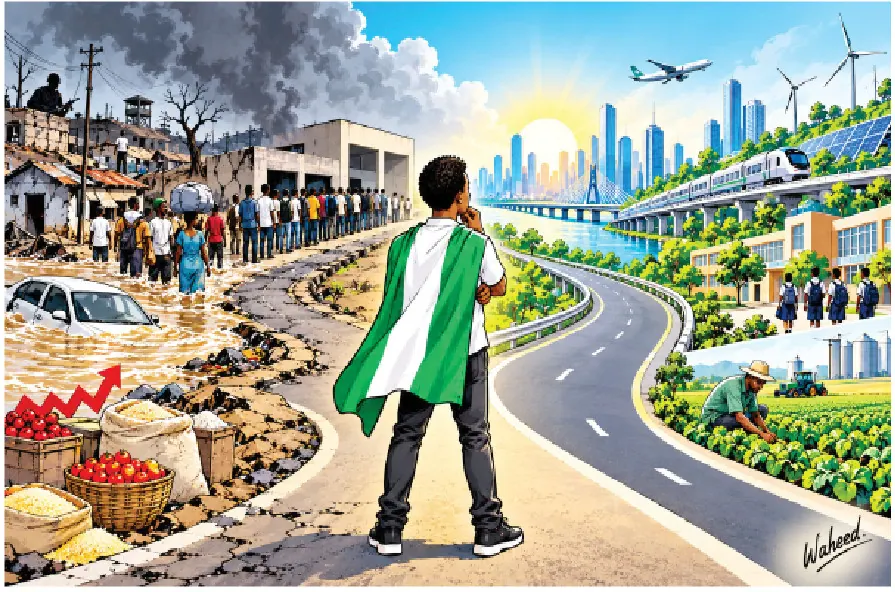
Nigeria's reactive approach to crises has become a recurring weakness, with government responses often coming too late. When floods hit Lagos, food prices rise in Kano, or classrooms overflow in Niger Delta communities, the government is expected to respond. However, the deeper policy question is what happened before the emergency became visible. This reactive approach has significant consequences, including increased costs and decreased effectiveness.
The concept of foresight or futures thinking can help Nigeria avoid this reactive approach. This approach, which involves exploring plausible futures, testing assumptions, and helping decisions remain useful when tomorrow refuses to resemble yesterday, was studied by the author at Stellenbosch University's Institute for Futures Research. Under the guidance of André Roux and Morné Mostert, the author gained a deeper understanding of trends, structural change, and systems interdependence.
Nigeria's policy environment is particularly vulnerable to the "tyranny of now," with annual budgets, five-year political horizons, sudden revenue pressures, and recurring emergencies encouraging short-term fixes. However, the demographic clock moves differently, with the UNFPA estimating Nigeria's population at 237.5 million in 2025, with 41 percent below 15 and 34 percent aged 10 to 24. This means millions of Nigerians will soon require education, skills, jobs, housing, transport, and healthcare.
The education sector is a prime example of the need for foresight. Nigeria has spent years debating access, teacher quality, examinations, and infrastructure, but another question is unavoidable: what happens to Nigerian graduates when artificial intelligence changes entry-level work in banking, accounting, customer service, software, media, and administration? A young population can become an economic advantage, but only if education and labour markets evolve together.
Horizon scanning can help government examine these possibilities before they become labour-market statistics. This involves looking beyond the headline indicator and examining forces that could produce different futures. For Nigeria, this means considering the interactions between insecurity, climate stress, high transport costs, currency pressures, and weak storage systems that may be reflected in a rise in food prices.
Nigerian institutions need to distinguish signal from noise, trend from fad, and weak signal from structural change. This requires a systems approach that considers the interconnections between different sectors and the potential consequences of different policy decisions. By doing so, policymakers can identify potential crises before they occur and develop effective solutions.
The consequences of not adopting a foresight approach can be severe. If Nigeria fails to anticipate and prepare for the challenges posed by its rapidly growing population, it risks experiencing increased poverty, inequality, and social unrest. However, by adopting a foresight approach, Nigeria can turn its demographic strength into a demographic advantage and create a more sustainable and equitable future.
Key points
- Nigeria's reactive approach to crises is a recurring weakness that can be addressed through foresight and futures thinking.
- The country's demographic clock is moving rapidly, with significant implications for education, skills, jobs, housing, transport, and healthcare.
- Horizon scanning and systems thinking can help Nigerian institutions anticipate and prepare for potential crises.