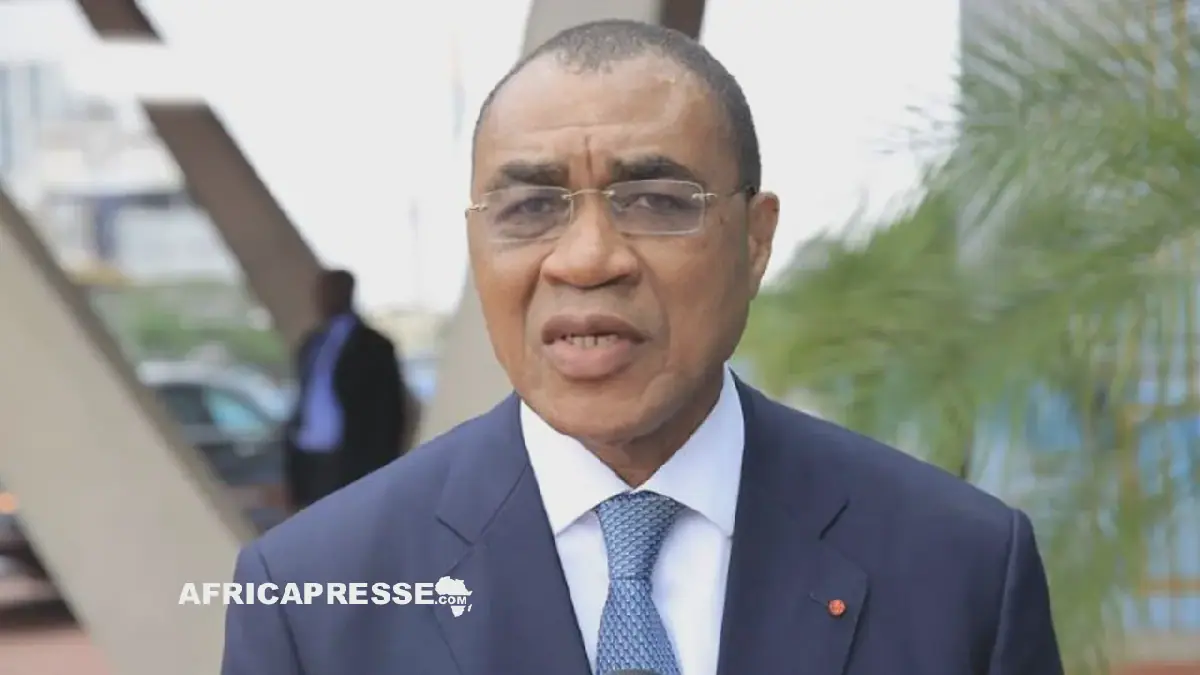
The Ivoirian Minister of Economy, Finance and Budget, Adama Coulibaly, has called on Economic Community of West African States (ECOWAS) member countries to accelerate reforms necessary for the implementation of the ECO, a single community currency. This call was made on November 20, 2026, in Abidjan, during the opening of the meeting of the Ministerial Committee of the Presidential Task Force on the ECOWAS single currency program.
Coulibaly emphasized the strategic importance of this meeting, which takes place at a decisive stage of the monetary integration process. He stated that the deadline of 2027, chosen for the gradual launch of the ECO, imposes decisive actions, rigorous implementation of the roadmap and sustained political commitment. The Minister reaffirmed Côte d'Ivoire's commitment to this community project, while stressing the need to strengthen the coordination of economic policies in the face of geopolitical tensions, regional insecurity, inflation and rising international interest rates.
According to Coulibaly, the acceleration of monetary integration is one of the shields against external shocks, the success of the ECO depending on solid economies and respect for macroeconomic convergence criteria. The ECOWAS single currency project has been supported by member states for over four decades, but has long remained at the stage of intentions. It was relaunched in recent years with the setting of the 2027 horizon for a gradual launch.
The Abidjan meeting is based on the conclusions of the Technical Committee of the Task Force, held from November 17 to 19, 2026. Discussions will focus on several determining points, including the designation of the host country and the modalities of governance of the future Central Bank of West Africa (BCEAO). The exchanges will also concern the choice of the country that will host the components of the payment and settlement system of ECOWAS.
General Birame Diop, President of the ECOWAS Commission, insisted on the challenge of mobilizing political commitment and setting up the institutional and technical devices necessary for the concretization of the monetary union. The expected advantages of the ECO include the facilitation of commercial exchanges, the reduction of transaction costs and the promotion of regional investments.
A single currency will facilitate cross-border commercial exchanges, making them simpler, more predictable and less expensive, according to General Diop. However, the meeting in Abidjan illustrates the persistent difficulty of the project: the most sensitive institutional decisions, particularly the localization of the organs of the future currency, remain to be arbitrated.
The question of macroeconomic convergence remains central: without budgetary discipline and harmonization of economic policies, the single currency risks reproducing the fragilities of previous regional monetary experiences. The Ivoirian Minister's call to accelerate reforms translates a simple reality: the 2027 deadline will only be achievable if member states quickly settle governance issues and respect convergence criteria.
Key points
- Côte d'Ivoire's commitment to the ECO project and its role as a driving force.
- The challenges of implementing the ECO, including the need for macroeconomic convergence and the localization of the organs of the future currency.
- The importance of the ECO in facilitating commercial exchanges and promoting regional investments.