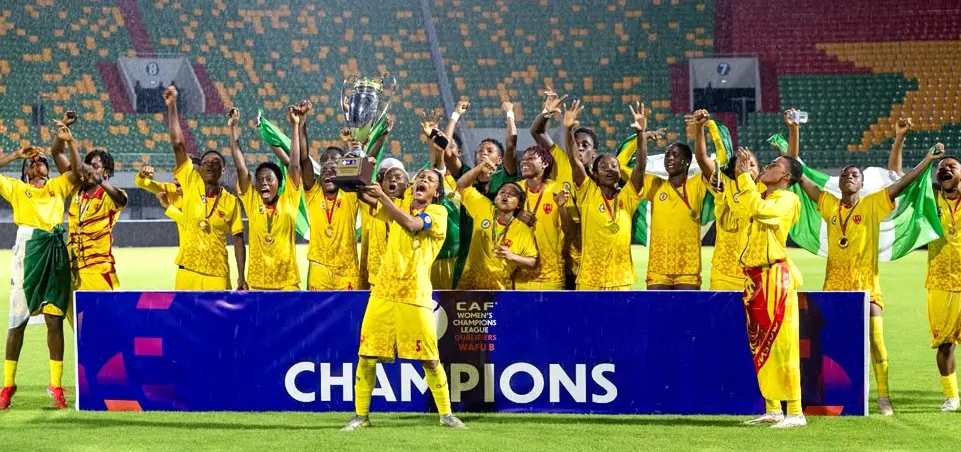
The Confederation of African Football's decision to annul Edo Queens' 4-1 penalty-shootout victory over Ghana's Ampem Darkoa Ladies in the WAFU-B final has raised fundamental questions about fairness, responsibility, and the consequences of an administrative error. The final, which ended 2-2 after 90 minutes on September 5 in Ouagadougou, was not played with the required two 15-minute periods of extra time before penalties, according to Article 72.4 of the competition regulations.
The Ghana Football Association published CAF's decision, stating that the failure to play extra time resulted from an administrative instruction and that neither Edo Queens nor Ampem Darkoa was responsible for the error. Despite this, the consequence of the error has fallen directly on the Nigerian champions, who won the shootout 4-1. CAF's own official report initially recorded the Nigerian side as the WAFU-B champion and stated that the victory secured qualification for the 2026 CAF Women's Champions League.
CAF published an official report on September 6, titled "Edo Queens beat Ampem Darkoa on penalties to win WAFU B women's title," which did not describe the shootout as provisional. The report stated that Edo Queens won 4-1 on penalties, secured the regional title, and qualified for the CAF Women's Champions League. CAF's broader qualification overview, published on September 7, also listed Edo Queens as the WAFU-B representative for the 2026 CAF Women's Champions League.
The central issue is not whether Article 72.4 exists, but whether annulling the shootout and ordering 30 minutes of additional football is the appropriate remedy when CAF itself says the clubs were not responsible for the procedural mistake. Edo Queens did not unilaterally decide to ignore the regulations and conduct a penalty shootout; the match officials controlled the procedure. The players then took the penalties and won 4-1, only for CAF to later determine that this was contrary to the applicable competition provisions.
CAF initially treated the final as properly concluded, but only after Ampem Darkoa's protest did CAF reverse its position and order the contest to continue. This sequence inevitably raises questions about consistency in CAF's administrative procedures. If the procedural irregularity was serious enough to invalidate the shootout, why was the result initially accepted, published, and used in CAF's official qualification information?
The disputed issue is responsibility and remedy. Edo Queens did not decide to bypass extra time, and Ampem Darkoa did not decide to bypass extra time. The available account of CAF's decision says the clubs were not responsible. Yet Edo Queens, having won the shootout 4-1 and been officially recognised as champions, has lost the immediate benefit of that victory.
Then comes another question: why not sanction those responsible for the administrative error and allow the winner of the WAFU-B final to proceed with its continental campaign, instead of creating another layer of uncertainty around the competition?
Key points
- CAF's decision to annul Edo Queens' WAFU-B victory has sparked questions about fairness and responsibility.
- The Nigerian champions were not responsible for the procedural error that led to the penalties.
- CAF initially treated the final as properly concluded before reversing its position after Ampem Darkoa's protest.