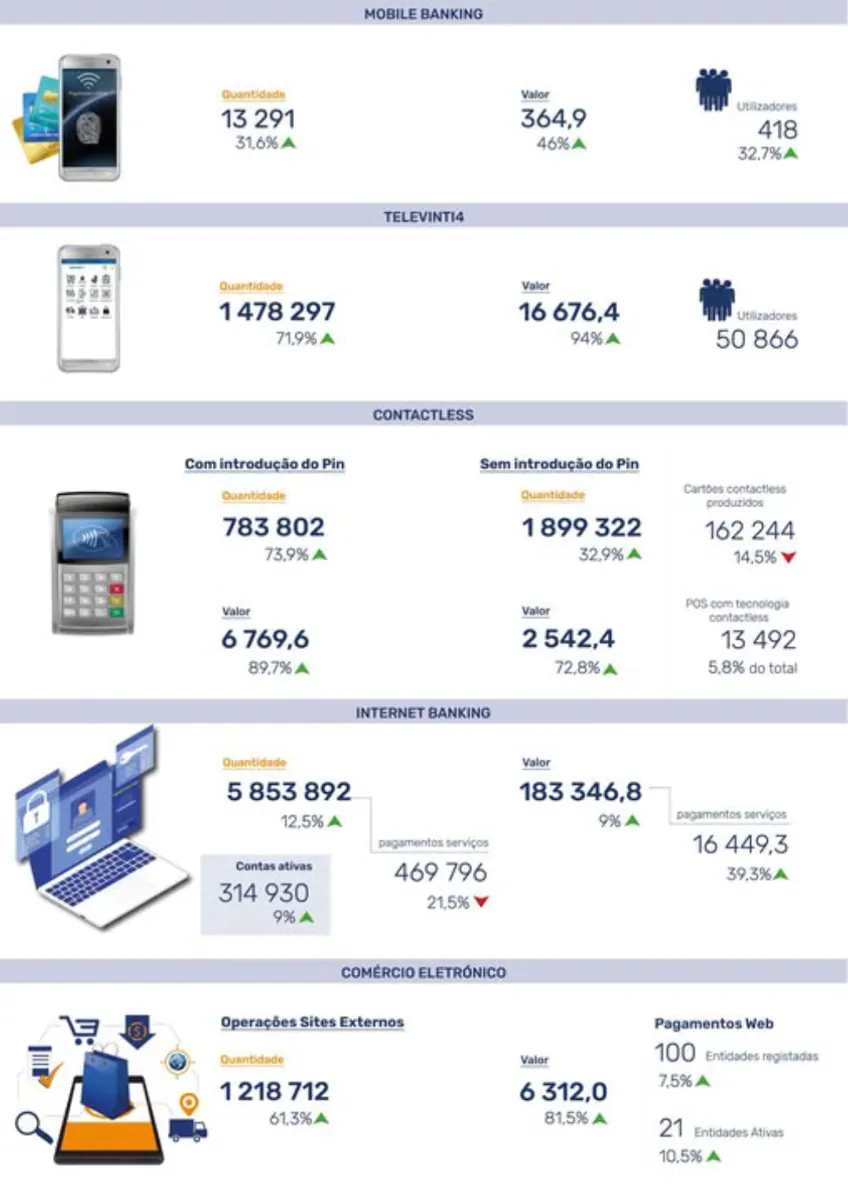
According to the 2025 Report on the Cabo Verdian Payment System by the Banco de Cabo Verde (BCV), the country's banking system saw significant growth in 2025. The report highlights an increase in residents with bank accounts, with the bankarization rate reaching 85.6%, up from 81.5% in 2024. This represents an increase of 4.1 percentage points, meaning that, on average, six out of seven residents in Cabo Verde had a bank or payment account by the end of 2025.
The number of new bank accounts opened in 2025 was 55,719, with 47,038 belonging to individuals. The total number of active bank accounts reached 751,118, a 2% increase from the previous year. Despite this growth, the physical network of banks saw a slight reduction, with the number of agencies and counters decreasing from 129 in 2024 to 127 in 2025. This reduction resulted from the transformation of two counters into services provided through bank agents.
Digital channels saw significant growth, with internet banking remaining the primary means of moving money. It accounted for 81.9% of operations with fund transfers through digital channels and concentrated 91.7% of the values moved. The number of active internet banking accounts reached 314,930 in 2025. Additionally, the Televinti4 service, which allows using the Vinti4 card through a mobile phone, saw substantial growth, with 50,866 users, up from 33,826 in 2024.
The use of payment cards continued to grow in 2025, with cards being the most widely used instrument for payments and other operations. Excluding cash, cards represented 89.3% of total operations, while transfers accounted for 9.9% and checks for 0.8%. The number of active payment cards in circulation reached 418,470, an increase of 37,925 from the previous year. On average, 151,001 card operations were carried out daily, moving around 643.4 million escudos per day.
Despite the growth of electronic payments, cash continues to be used significantly in the country. The value of notes and coins in circulation increased from 14.7 million escudos in 2024 to 16.3 million escudos in 2025, a 10.7% growth. The BCV notes that cash is particularly used in transactions related to the informal economy and small payments, such as transportation, groceries, bakeries, and purchases made from street vendors.
Behind the daily operations carried out by citizens and companies are systems that allow money to be transferred between banks and payments to be processed. In 2025, the Deposit and Liquidity Management System (SGDL) processed 56,871,876 payment operations, corresponding to a total value of 18,667,801.8 million escudos. Compared to 2024, the number of operations increased by 13.9%, while the total value liquidated grew by 42.8%.
The BCV also highlighted the progress of the Immediate and Inclusive Transfers System (STII) project, which aims to allow immediate payments and facilitate access to this type of service for the population. The new service is expected to be available in 2026. In 2025, the Banco de Cabo Verde advanced with the governance structure of the project, the definition of its strategic objectives, and other necessary stages for implementation.
Key points
- The bankarization rate in Cabo Verde reached 85.6% in 2025, up from 81.5% in 2024.
- The number of active payment cards in circulation reached 418,470 in 2025.
- The value of notes and coins in circulation increased by 10.7% in 2025.