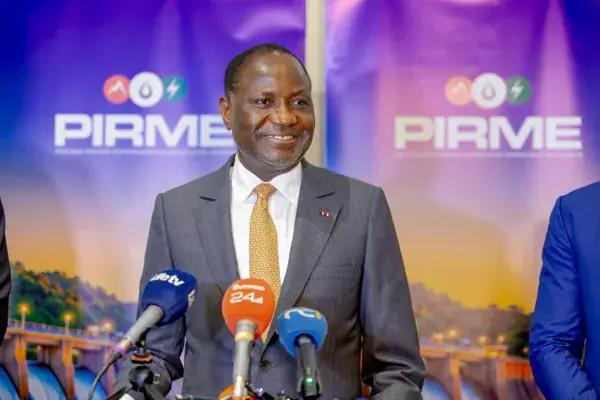
Côte d'Ivoire has launched a new strategy to transform its economy, with a focus on the mining, oil, and energy sectors. The country's Minister of Mines, Oil, and Energy, Mamadou Sangafowa-Coulibaly, presented the Integrated Mineral Resources and Energy Policy (PIRME) on November 9, 2026, in Abidjan. The policy aims to double the contribution of these sectors to the country's GDP by 2040.
The PIRME is part of President Alassane Ouattara's vision to make Côte d'Ivoire an upper-middle-income country by 2030. The policy involves a $66 billion investment plan, with 88% of the funding expected to come from the private sector and 12% from the public sector. The investments will be deployed in three phases: $20 billion from 2025-2029, $36 billion from 2030-2035, and $10 billion from 2036-2040.
The investment plan allocates 41% to the energy sector, 29% to hydrocarbons, and 30% to mining. The funds will support several major projects, including the construction of a mineral port in San Pedro, the development of 474 kilometers of railway lines for mineral transportation, and the construction of a second oil refinery in San Pedro.
The PIRME sets specific targets for the country's mining, oil, and energy sectors. By 2040, Côte d'Ivoire aims to produce 500,000 barrels of oil per day, increase its installed electricity capacity to 11,400 MW, and make renewable energy account for 49% of its electricity mix. The country also aims to produce 150 tons of refined gold and locally valorize 1.25 million tons of manganese per year.
The policy also aims to increase the proportion of nationals in the extractive and energy industries to 95%. This move is part of the government's efforts to ensure that Côte d'Ivoire benefits more from its natural resources. The country plans to become one of the top five African oil producers by 2035 and the continent's largest gold producer by the same year.
The development of the mining, oil, and energy sectors is crucial to Côte d'Ivoire's economic growth. The country's economy has traditionally been driven by agriculture, but the government wants to diversify and reduce its dependence on traditional sectors. The PIRME is expected to create jobs, stimulate economic growth, and make Côte d'Ivoire a major player in the African mining and energy sectors.
The implementation of the PIRME will require close coordination between the government, private sector, and other stakeholders. The policy's success will depend on the effective allocation of resources, the development of infrastructure, and the participation of local communities. If successful, the PIRME could transform Côte d'Ivoire's economy and make the country a major economic power in West Africa.
Key points
- The Côte d'Ivoire government plans to invest $66 billion in the mining, oil, and energy sectors by 2040 to double their contribution to the country's GDP.