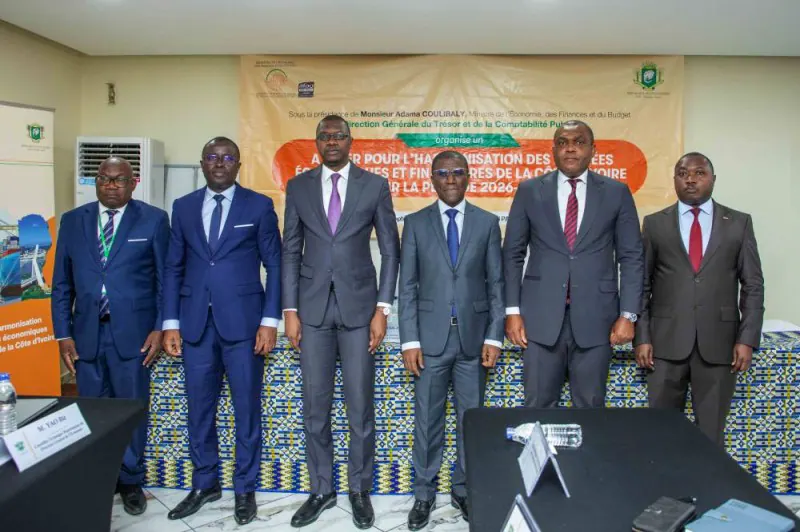
A five-day workshop was held in Grand-Bassam from September 21-25, 2026, to discuss the harmonization of Côte d'Ivoire's economic and financial data for 2026-2031. The workshop, led by Touré Vakaramoko, director of statistical coordination, brought together experts from public and parapublic administrations responsible for macroeconomic forecasts and sectoral statistics. The event was attended by Ahoussi Arthur Augustin Pascal, director general of the Treasury and Public Accounting, representing the minister of economy, finance, and budget.
The workshop aimed to review the implementation of the 2023-2026 economic and financial program, assess its main results, and draw lessons for the upcoming period. Participants also worked to ensure the coherence of macroeconomic accounts and revise the 2026-2031 macroeconomic framework. According to the director general, the workshop's findings indicate that Côte d'Ivoire is displaying good economic and financial health.
The report produced at the workshop projects that Côte d'Ivoire will experience one of the strongest growth rates in 2026, at 6.2%, compared to 4.3% in sub-Saharan Africa. This growth is expected to continue from 2027 to 2030. Inflation is projected to be 2.2% in 2026, below the 3% community norm. The budget deficit is expected to be 3.8% of GDP.
The reforms implemented during the previous economic and financial program are expected to lead to continued budget consolidation in the medium term, despite global economic challenges. The current account balance is projected to be -1.5% of GDP, supported by a surplus in the goods account.
The implementation of the National Development Plan (PND) 2026-2030 is expected to lead to continued public investment in high-priority infrastructure and social projects, aimed at reducing poverty, increasing the transformation of raw materials, and improving farmers' incomes.
The director general expressed satisfaction with the workshop's outcomes, stating that the document produced will serve as a strategic orientation tool for the government's economic and budgetary policy decisions. He also committed to transmitting the results and recommendations to his superiors and ensuring the minister's support for future consultations with the International Monetary Fund (IMF).
The workshop's conclusions and recommendations are expected to play a significant role in shaping Côte d'Ivoire's economic and financial policies for the next five years. The country's economic growth and stability are crucial for the region, and the government's efforts to consolidate its finances and invest in key sectors are seen as positive steps.
Key points
- Côte d'Ivoire's economy is projected to grow at 6.2% in 2026.
- The country's inflation rate is expected to be 2.2% in 2026, below the community norm.
- The budget deficit is projected to be 3.8% of GDP.