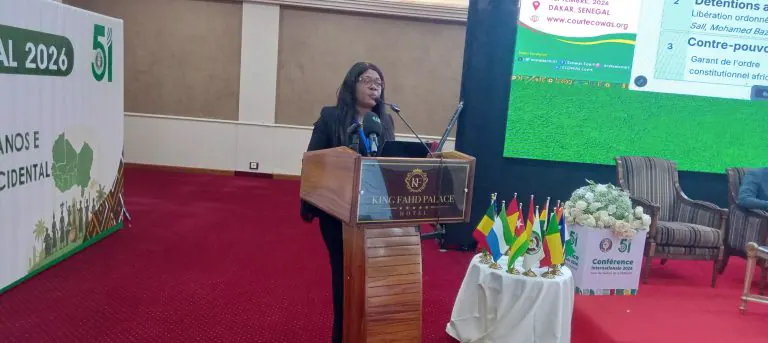
Dr. Patricia Ambeu, a magistrate at the Conseil d'État de Côte d'Ivoire, has commended the ECOWAS Court of Justice for its significant impact on human rights protection in West Africa. Speaking at the International Conference of the ECOWAS Court of Justice in Dakar on September 21, 2026, Dr. Ambeu emphasized that the court has evolved into a genuine regional space for protecting fundamental rights. She noted that the court's role has expanded beyond merely settling disputes between states.
According to Dr. Ambeu, the ECOWAS Court has facilitated access to community justice for individuals, eliminating the need for prior exhaustion of all internal appeals. She cited the case of Jean Pierre Fabre v. Togo, which was judged on April 9, 2025, as an example. Additionally, Dr. Ambeu highlighted that organizations of civil society can also approach the court, as demonstrated by the SERAP v. Nigeria case in 2009.
Dr. Ambeu also underscored the court's broadening of protected rights. The case of Hadijatou Mani Koraou v. Niger established that no tradition or social practice can justify an infringement on human dignity. Furthermore, cases such as SERAP v. Nigeria have contributed to making economic and social rights justiciable, particularly in the areas of education and environment.
The magistrate welcomed the court's openness to emerging issues, including the digital sphere. She referenced the case of ASUTIC and Ndiaga Gueye v. Senegal, in which the court condemned mass internet shutdowns during political demonstrations on May 14, 2025. Dr. Ambeu emphasized that the internet has become essential for exercising freedom of expression, accessing information, and participating in democratic life.
Dr. Ambeu noted that the ECOWAS Court has established itself as a regional guarantor of the rule of law through its jurisprudence on electoral processes in Burkina Faso and Senegal. She also cited cases related to protecting individual freedoms and democratic pluralism, such as those involving Khalifa Aboubacar Sall and Mohamed Bazoum.
Despite these advancements, Dr. Ambeu identified several challenges, including the absence of a comprehensive and unique catalog of rights, inconsistent execution of judgments, and difficulties in accessing community justice. She stressed that an unexecuted decision remains an incomplete protection and that the authority of jurisprudence is measured by its concrete impact on the lives of individuals.
To address these challenges, Dr. Ambeu advocated for strengthened pedagogy around the court's competencies, decentralization of hearings, digitalization of procedures, and increased dialogue with national jurisdictions. She emphasized that the future of the ECOWAS Court will be built in collaboration with national jurisdictions, universities, legal practitioners, civil society, and citizens to ensure that proclaimed rights become truly lived experiences.
Key points
- Dr. Patricia Ambeu praises ECOWAS Court for transforming human rights protection in West Africa.
- The court has facilitated access to community justice for individuals and civil society organizations.
- Dr. Ambeu calls for strengthened dialogue between national and community judges to ensure effective protection of human rights.