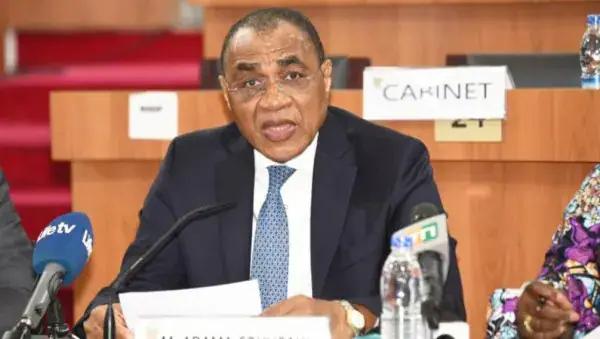
The Commission des affaires économiques et financières (CAEF) of Côte d'Ivoire's parliament has unanimously approved two key budgetary texts. On November 5, 2026, the CAEF adopted the draft law on the definitive regulation of the 2025 state budget and the draft law on the rectification of the 2026 budget. The approval came after a thorough examination and discussions with Adama Coulibaly, the Minister of Economy, Finance, and Budget.
The 2025 budget regulation law and the 2026 rectification law were approved by 41 out of 43 members of the CAEF. The discussions focused on the country's economic performance, debt management, public expenditure efficiency, and the impact of the international conjuncture on state finances. Minister Adama Coulibaly defended the 2025 budget, highlighting the resilience of the Ivoirian economy, which recorded a 6.5% growth rate despite a challenging international environment.
The parliamentary debates also addressed concerns raised by opposition parties, including the level of Côte d'Ivoire's debt and the monitoring of public project execution. Although the opposition parties raised several concerns, they ultimately voted in favor of the draft laws, demonstrating institutional responsibility. Minister Coulibaly clarified discrepancies between government and Court of Accounts figures on the budget deficit, attributing the differences to methodological and calculation scope variations.
Minister Coulibaly reassured parliamentarians about controlling the wage bill, stating that Côte d'Ivoire respects the community ceiling of 35% of fiscal revenues. He attributed delays in public investment implementation to environmental and social safeguard procedures and population indemnification operations. On public debt, Coulibaly defended the government's strategy, describing an active and strategic debt management approach that reduced Côte d'Ivoire's risk from moderate to low.
The second part of the discussions focused on the 2026 rectification budget law. Minister Coulibaly justified the revision due to changes in the international economic conjuncture, including rising oil prices and a decline in the cocoa market. The government readjusted the general budget, increasing it by over 22.5 billion FCFA to 17,372.68 billion FCFA, while maintaining a budget deficit of 3.8% of GDP.
The revised budget takes into account a slowdown in economic growth prospects, estimated at 6.2%. Minister Coulibaly acknowledged that this slowdown could affect state revenues, particularly tax collections. He also addressed the impact of the international conjuncture on the living conditions of populations, particularly in light of rising fuel prices, and highlighted government support mechanisms to mitigate the effects.
To preserve public resources and support growth, the government plans to pursue several structural reforms, including accelerating industrialization, modernizing customs services, and implementing a plan to rationalize public expenditure. Minister Coulibaly assured that the quasi-totality of public resources will be optimized to support the country's economic development.
Key points
- Côte d'Ivoire's parliament approves 2025 budget and 2026 budget revision
- The country's economy recorded a 6.5% growth rate in 2025
- The government plans to pursue structural reforms to support growth and preserve public resources