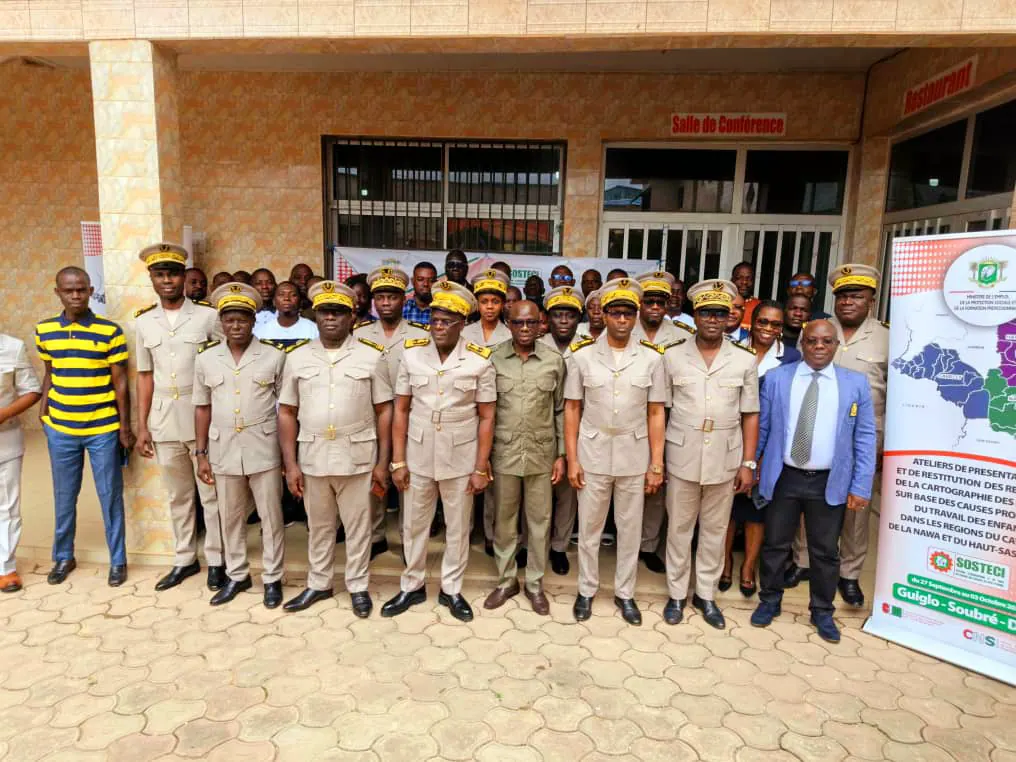
The Ivoirian government, through the Agence Ivoirienne de Presse (AIP), has presented the results of a child labor risk mapping exercise in the Nawa region. The exercise, conducted on September 28, 2026, in Soubré, aimed to identify areas of vulnerability and risk for children in the region. The mapping, part of the deployment of the Child Labor Observation and Monitoring System in Côte d'Ivoire (SOSTECI), provides a comprehensive understanding of the factors contributing to child labor.
The workshop, presided over by Soubré Regional Prefect, Kouamé Bi Kalou Clément, brought together local stakeholders to discuss the findings and implications of the mapping exercise. The results, presented by Statistician Zego Moïse from the Directorate for the Fight Against Child Labor (DLTE), highlighted the Nawa region's moderate risk level regarding exposure of children to hazardous work. The mapping tool takes into account socio-economic and educational indicators, as well as the quality and accessibility of basic social infrastructure.
In his opening remarks, Prefect Kouamé Bi Kalou Clément commended efforts to protect children and emphasized the need to consider territorial disparities and specific vulnerabilities in implementing responses. He encouraged participants to take ownership of the SOSTECI, described as a tool for monitoring, alerting, and intervening in child protection matters. The meeting also featured a presentation of the online platform www.cartorisquepfte.ci, which facilitates data collection and updating.
The exercise is part of the government's efforts to combat child labor, led by the Ministry of Employment, Social Protection, and Vocational Training, under Adama Kamara's leadership. The ministry's efforts have been acknowledged by N'Guétia Martin, Director of the Fight Against Child Labor and Executive Secretary of the Interministerial Committee to Fight Trafficking, Exploitation, and Child Labor (CIM). Martin expressed gratitude to stakeholders involved in the fight against child labor.
The dynamic mapping complements static mapping by providing verifiable and regularly updated field data. According to N'Guétia Martin, this exercise aims to identify the most exposed sectors and guide public intervention. The data collected will be used to inform policy decisions and interventions to mitigate child labor risks in the region. The stakeholders' engagement has facilitated the completion of certain information gaps and generated proposals to enhance data collection and updating.
The SOSTECI tool is expected to enhance the government's ability to monitor and respond to child labor incidents in the region. By engaging local stakeholders, the government aims to ensure that the system is effective and sustainable. The exercise demonstrates the government's commitment to protecting children's rights and promoting a protective environment.
The workshop concluded with a renewed commitment from stakeholders to collaborate in the fight against child labor. The Ivoirian government will continue to engage stakeholders in the Nawa region and beyond to ensure the effective implementation of the SOSTECI and other initiatives aimed at protecting children from labor exploitation.
Key points
- The Ivoirian government presents child labor risk mapping results in the Nawa region to enhance protection and intervention efforts.