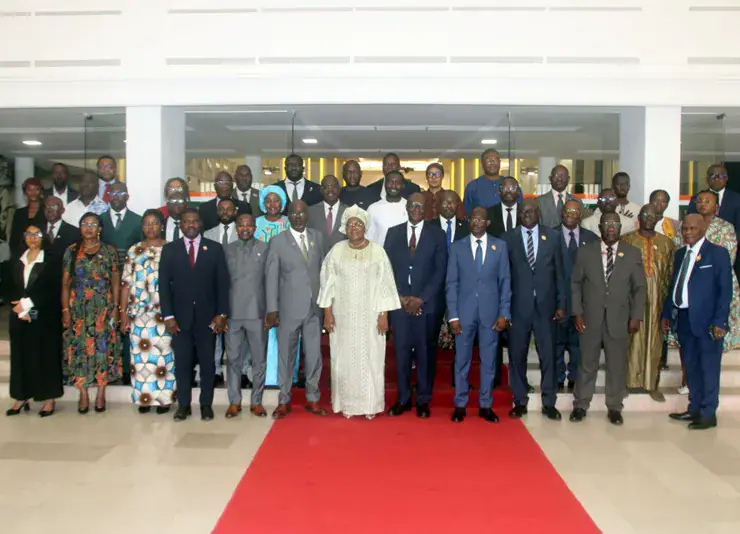
The Ivorian National Assembly in Abidjan hosted a two-day seminar on November 27, 2026, focused on reinforcing parliamentary oversight of the country's climate law. Organized by the Assemblée parlementaire de la Francophonie (APF), the event aims to equip lawmakers with the necessary tools to effectively monitor the implementation of the 2025 climate law. The law, which was adopted on June 25, 2025, outlines the country's commitment to mitigating the effects of climate change.
The seminar, themed "Côte d'Ivoire's Climate Change Law: From Appropriation to Parliamentary Control," seeks to build the capacity of Ivorian parliamentarians to ensure the effective implementation of the climate law. Through its Commission on Economic, Social, and Environmental Affairs (CAESE), the APF is supporting francophone parliaments in developing and enforcing climate legislation. The APF's legislative corpus on climate change, published in March 2024, serves as a key resource in this effort.
Vice-President Traoré Fatoumata épouse Diop, representing National Assembly President Patrick Achi, emphasized that while the adoption of the climate law is a significant step forward, its success hinges on concrete measures. She called for the acceleration of implementing decrees, mobilization of necessary budgetary resources, and monitoring of climate commitments. Diop outlined three priorities for parliamentarians: mastering the legal framework, leveraging climate data to assess progress, and tracking national and international climate funding.
Dah Sansan Tilkouété, acting president of the Ivorian section of the APF, advocated for greater transparency in climate resource allocation within finance laws, enabling lawmakers to monitor their use. He also recommended strengthening parliamentary oversight mechanisms through hearings, field missions, and regular government reporting. These efforts are crucial in the context of Côte d'Ivoire's growing vulnerability to climate change impacts, including coastal erosion, disrupted rainy seasons, and recurrent flooding.
According to Tilkouété, the World Bank projects that Côte d'Ivoire's GDP could decline by up to 13% by 2050 without sufficient adaptation measures. He also noted that the country accounts for only about 0.12% of global greenhouse gas emissions, raising questions about climate justice. Bachir Dièye, a senior advisor representing APF Secretary General Amélia Lakrafi, stressed the responsibility of parliaments in translating climate commitments into effective public policies.
Dièye called for better appropriation of national commitments, control of public spending, and enhanced cooperation among francophone parliaments to facilitate experience sharing. The seminar's agenda includes discussions on climate governance, transparency, financing mechanisms, and monitoring of national commitments. A meeting with students and teachers from the Université Félix Houphouët-Boigny is also planned.
The Ivorian government's efforts to address climate change are critical, given the country's vulnerability to its impacts. The seminar's outcomes are expected to contribute to more effective implementation of Côte d'Ivoire's climate law and, ultimately, to the country's resilience in the face of climate change.
Key points
- Ivorian parliamentarians are urged to strengthen oversight of climate law implementation.
- The country's vulnerability to climate change impacts, including coastal erosion and flooding, underscores the need for effective action.
- Enhanced transparency and accountability in climate resource allocation are crucial for successful implementation of the climate law.
Reporting sources
- Côte d’Ivoire-AIP/ Les parlementaires appelés à renforcer le contrôle de l’application de la loi climat · Agence ivoirienne de presse