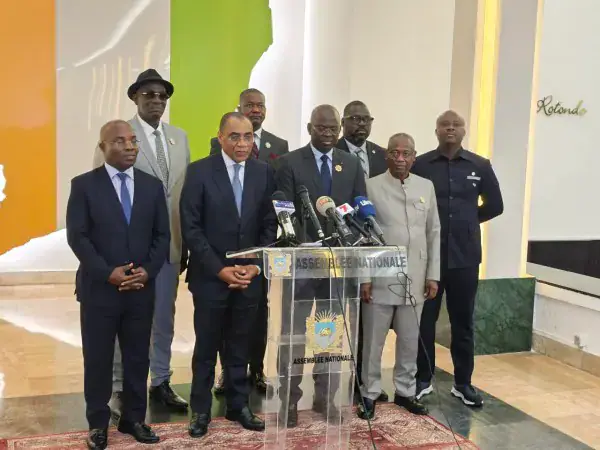
The Economic and Financial Affairs Committee of Côte d'Ivoire's National Assembly unanimously adopted two major bills on November 4, 2026. The bills focus on modernizing the country's banking sector and the fourth phase of tariff dismantling under the Economic Partnership Agreement (EPA) with the European Union. The committee, comprising 43 members, had 40 members present, all of whom voted in favor of the bills.
The first bill examined by parliamentarians relates to banking regulations. This reform aims to align Côte d'Ivoire's legal framework with new community dispositions adopted within the West African Economic and Monetary Union (UEMOA). According to Minister of Economy, Finance, and Budget Adama Coulibaly, this evolution has become indispensable due to significant changes in the financial sector and the emergence of new actors and services.
The new regulatory framework seeks to integrate Islamic finance activities, financial technologies (FinTech), and electronic money operations. It also aims to group various financial actors, including banks, credit financial institutions, payment establishments, and electronic money issuers, under a harmonized regulatory framework. The government's goal is to strengthen sector supervision, improve regulation mechanisms, and better regulate new financial activities.
The bill also introduces a mechanism for early intervention to anticipate and manage difficulties faced by banking establishments before liquidation becomes necessary. Discussions during the session addressed concerns about banking system functionality, including bank fees, client protection conditions, and the level of bank penetration.
The second adopted bill concerns the fourth phase of tariff dismantling under the EPA between Côte d'Ivoire and the EU. Minister Adama Coulibaly presented the financial outcome of the first three implementation phases of this agreement. As of September 30, 2025, cumulative losses of customs revenue were estimated at over 28.4 billion FCFA, compared to an initial forecast of 120.69 billion FCFA.
The minister attributed the difference to the low utilization rate of the agreement by economic operators, which was estimated at 13.5% in 2025. The fourth phase involves an additional 1,074 tariff lines, bringing the total number of lines affected by dismantling to 4,459. For 2026, estimated losses of customs revenue related to this phase are 45.44 billion FCFA.
The adoption of these bills marks a new step in Côte d'Ivoire's economic modernization program, aiming to equip the banking sector with a legal framework better adapted to financial innovations and more protective for users. The reforms also reflect the country's commitment to advancing trade with the EU while seeking to balance international commercial engagements with national economic interests.
Key points
- The Economic and Financial Affairs Committee of Côte d'Ivoire's National Assembly has unanimously adopted two major bills aimed at modernizing the country's banking sector and advancing trade with the European Union.
- The banking reform bill seeks to integrate Islamic finance activities, financial technologies, and electronic money operations under a harmonized regulatory framework.
- The fourth phase of tariff dismantling under the EPA with the EU involves an additional 1,074 tariff lines and is expected to result in customs revenue losses of 45.44 billion FCFA in 2026.