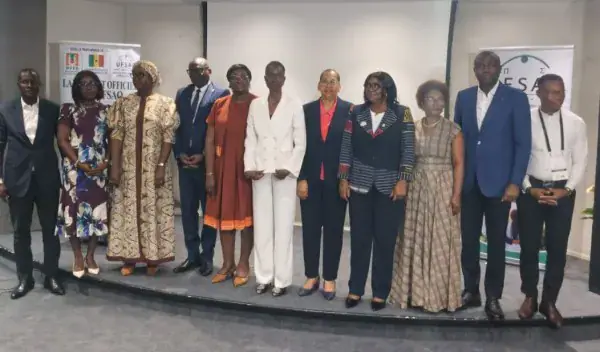
The Union des Femmes Scientifiques d'Afrique de l'Ouest (UFSAO) was officially launched in Abidjan, Côte d'Ivoire, with the goal of promoting women's leadership in science and encouraging young girls to pursue scientific careers. The initiative, led by Sali Sène Ouattara, aims to create a network of women scientists and mentors to support each other and future generations. The launch was attended by various stakeholders, including government officials, international organizations, and scientific institutions.
UFSAO's vision for 2030 includes uniting 500 women scientists, mobilizing 2,000 mentors, and mentoring 7,000 young girls. The organization also plans to establish partnerships with 30 universities and institutions. This collective effort aims to break down social, educational, and professional barriers that hinder women's participation in scientific fields in West Africa. By promoting women's participation in research, innovation, and technological development, UFSAO hopes to make a significant impact on the continent.
Sali Sène Ouattara, president of UFSAO, emphasized the importance of collective responsibility and knowledge transfer in achieving the organization's goals. She noted that despite the presence of talented women scientists in Africa, many face obstacles in their careers, and young girls are often discouraged from pursuing scientific fields. UFSAO aims to provide a platform for women scientists to network, share experiences, and support one another.
UFSAO has already made significant progress, with over 100 women scientists as members and a pool of 110 mentors identified in 13 countries. A pilot mentorship program has been launched in Côte d'Ivoire, Senegal, Burkina Faso, and Benin, with the goal of mentoring 100 young girls. The organization plans to expand its reach to other countries in the West African Economic and Monetary Union (UEMOA) and beyond.
Georgette Brou, director of Equity and Gender at the Ministry of National Education, highlighted the importance of initiatives like UFSAO in promoting women's participation in science. She noted that the underrepresentation of girls in scientific fields is not due to a lack of ability, but rather to social and structural factors such as gender stereotypes and limited access to role models.
The Ministry of National Education has launched several initiatives to encourage girls to pursue scientific careers, including the "STEM for Her" program. This program provides support and resources for girls interested in science, technology, engineering, and mathematics. UFSAO's efforts complement these initiatives, providing a regional framework for promoting women's participation in science.
UFSAO's launch marks a significant step towards promoting women's empowerment in science in West Africa. With the support of various stakeholders, the organization is poised to make a lasting impact on the continent. As Sali Sène Ouattara stated, "Our ambition is to make science a lever of cooperation, emancipation, innovation, and sovereignty for Africa."
Key points
- UFSAO aims to unite 500 women scientists and mentor 7,000 girls by 2030.
- The organization plans to establish partnerships with 30 universities and institutions.
- UFSAO's efforts aim to break down social, educational, and professional barriers hindering women's participation in scientific fields in West Africa.