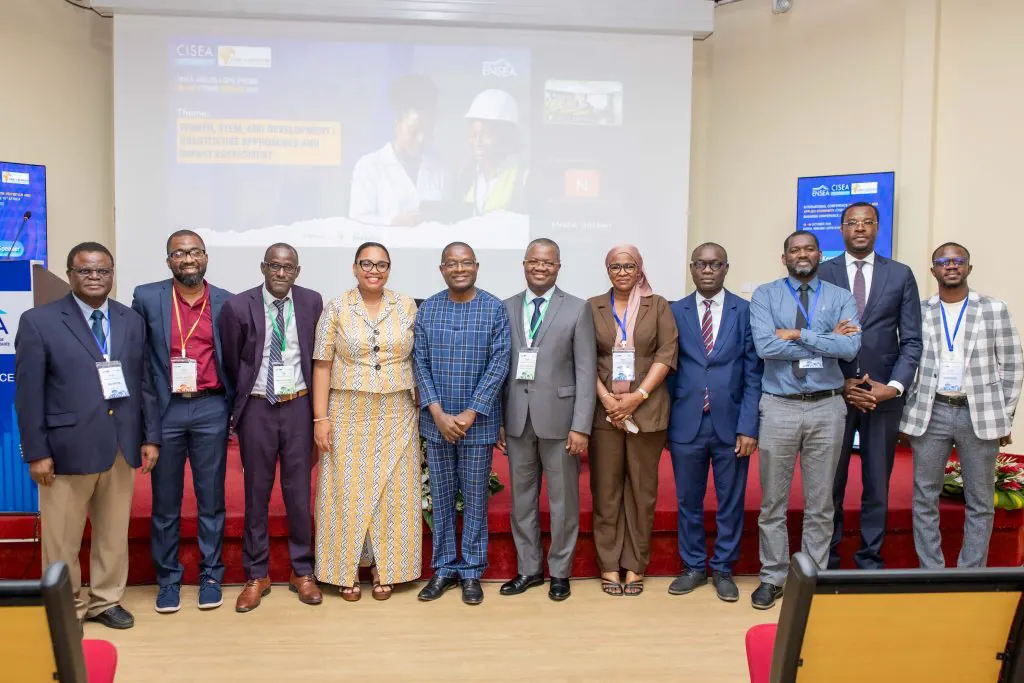
The Director-General of the National School of Statistics and Applied Economics (ENSEA) in Côte d'Ivoire, Dr. Hugues Kouadio, has emphasized the need for increased participation of women and girls in scientific and technological fields. He made this statement during the opening of the 4th International Conference on Statistics and Applied Economics (CISEA) in Abidjan. The conference aims to highlight the role of women in science, technology, engineering, and mathematics (STEM) as a lever for economic and inclusive development.
The conference, organized in collaboration with the 15th Africa Business and Entrepreneurship Research Society (ABERS), brings together researchers, academics, professionals, students, and development actors. Dr. Kouadio noted that every young girl who gives up on a scientific field due to lack of encouragement, resources, or prospects represents a lost talent for society and a potential contribution to innovation that may not be realized. He called on education and research stakeholders to better understand the obstacles limiting girls' access to science.
Dr. Kouadio stressed the importance of statistics and quantitative approaches in evaluating public policies that promote women's participation in science. He encouraged participants to identify effective interventions, target audiences, and devices that can facilitate girls' access to scientific fields. The conference aims to provide a platform for experts to share experiences, exchange ideas, and develop concrete recommendations for policymakers, training institutions, and development partners.
The ENSEA Director-General highlighted the evolution of the international conference, which was established to make the school a hub for international scientific dialogue. He recalled previous editions focused on statistics and digital economy, climate change, and economic performance. Dr. Kouadio emphasized that the conference's continuity reflects a shared ambition to mobilize statistical and economic tools to understand contemporary transformations and inform public responses.
The three-day conference (October 6-8) aims to advance knowledge and develop concrete recommendations for stakeholders. Dr. Kouadio expressed his wish for the conference to contribute to expanding opportunities for women and girls in scientific and technological fields. He acknowledged the support of institutional and technical partners, including the West African Economic and Monetary Union (UEMOA) and the World Bank.
Dr. Kouadio also emphasized the importance of training statisticians and economists who can produce reliable data, interpret it with discernment, and draw useful lessons for decision-making. He invited young researchers and doctoral students to take advantage of the conference to present their work, exchange ideas, and establish new collaborations. The conference offers a hybrid format, allowing participants to engage in person or remotely.
The conference's outcomes are expected to contribute to a better understanding of the role of women in STEM fields and their impact on economic development. Key points discussed during the conference include the need for increased participation of women and girls in scientific fields, the importance of statistics and quantitative approaches in evaluating public policies, and the role of education and research stakeholders in promoting girls' access to science.
Key points
- The conference aims to promote women's participation in STEM fields.
- The conference highlights the importance of statistics and quantitative approaches in evaluating public policies.
- The conference seeks to develop concrete recommendations for stakeholders to support women's participation in science.