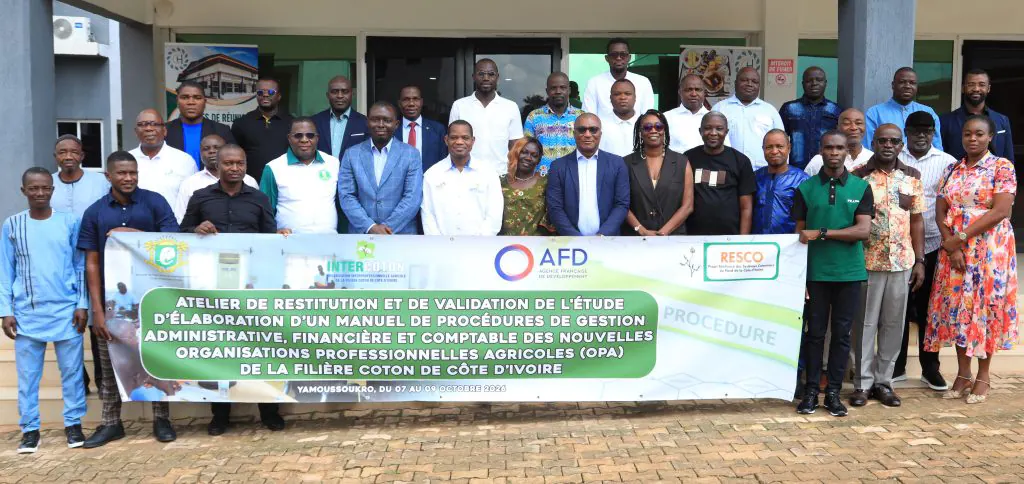
Abidjan, Côte d'Ivoire - In a bid to strengthen the governance and economic viability of cotton cooperatives, the Organisation interprofessionnelle agricole de la filière coton de Côte d'Ivoire (INTERCOTON) recently organized a workshop to develop a manual of procedures for the management of agricultural professional organizations (OPA). The workshop, held in Yamoussoukro on October 8-9, 2026, aimed to provide a common framework for harmonizing management practices, clarifying responsibilities, and ensuring transparency in resource utilization.
The initiative is part of the Projet de résilience des systèmes cotonniers du Nord de la Côte d'Ivoire (RESCO), which seeks to consolidate the organizational and institutional capacities of cotton industry stakeholders. Cofinanced by the Ivoirian government, the Agence française de développement (AFD), and INTERCOTON, the project focuses on enhancing the capacities of OPA and their umbrella structures. The manual's development is a key component of the project's sub-component 4.1.
The workshop brought together representatives of beneficiary organizations to present the study's findings, examine proposed procedures, and gather observations. The discussions led to the identification of necessary adjustments to finalize the document, ensuring its adaptability to the operational realities of cooperatives. Silué Siontiamma Jean-Baptiste, INTERCOTON's executive director and RESCO project coordinator, emphasized the manual's importance as a management tool to prevent errors and improve administrative, financial, and accounting operations.
According to Kassoum Silué, director-general of the Fédération des producteurs de coton de Côte d'Ivoire (FPC-CI), the manual will formalize management processes, specify tasks and responsibilities, and identify necessary means for executing operations. This initiative is expected to contribute to the professionalization of producer organizations, improve governance, and enhance financial autonomy, ultimately consolidating and strengthening the Ivoirian cotton industry.
The manual is designed to provide a common reference point for cotton cooperatives, promoting harmonized management practices and transparency. By adopting this manual, cooperatives can improve their management, ensuring better use of resources and more effective operations. This development is seen as a crucial step towards the long-term sustainability and resilience of the cotton sector in Côte d'Ivoire.
The RESCO project's efforts to enhance the capacities of OPA and their structures are ongoing, with a focus on supporting the growth and development of the cotton industry. By strengthening the governance and economic viability of cotton cooperatives, INTERCOTON and its partners aim to promote a more robust and resilient cotton sector, ultimately benefiting Ivoirian farmers and the broader economy.
The development of the manual marks a significant milestone in the RESCO project's implementation. With its adoption, cotton cooperatives in Côte d'Ivoire can look forward to improved management practices, enhanced transparency, and more effective use of resources, ultimately contributing to the sector's long-term sustainability and growth.
Key points
- Development of a manual to improve governance and economic viability of cotton cooperatives
- Initiative part of the Projet de résilience des systèmes cotonniers du Nord de la Côte d'Ivoire (RESCO)
- Manual aims to promote harmonized management practices, transparency, and financial autonomy among cotton cooperatives