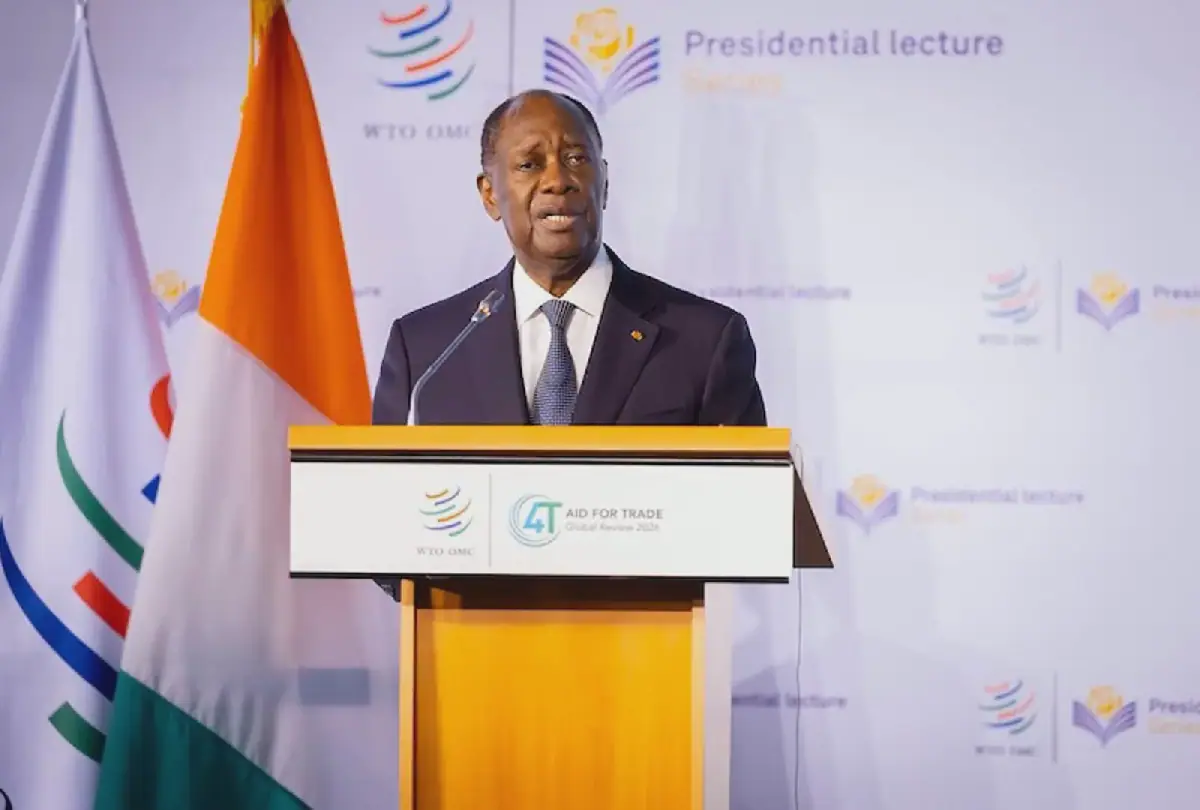
On October 29, 2026, in Geneva, Switzerland, Ivoirian President Alassane Ouattara presented a strategy to accelerate the local transformation of raw materials, focusing on industrial investments, export diversification, and value-added creation. This approach is part of the country's National Development Plan (PND) 2026-2030. Ouattara emphasized the need to shift from exporting raw materials to producing high-value-added goods.
The Ivoirian economy has shown resilience, with an average growth rate of 7% between 2012 and 2025. According to the World Bank's 2025 Country Policy and Institutional Assessment (CPIA), Côte d'Ivoire scored 4 out of 6, ranking second among African countries and first in West Africa. Ouattara highlighted these achievements as a foundation for further development.
Côte d'Ivoire has made progress in transforming its raw materials, with a cocoa transformation rate of 41% in the 2024-2025 campaign and 43% for cashews in 2025. The government aims to increase these rates, with a target of at least 80% for cashew transformation by 2030. The focus is on improving product quality, productivity, and market access.
To achieve these goals, the Ivoirian government will prioritize the development of agro-industry, infrastructure modernization, human capital reinforcement, and private investment promotion. The PND 2026-2030 will ensure better coordination of economic and sectoral policies, mobilizing necessary resources for productive apparatus transformation.
President Ouattara also emphasized the importance of African economic integration, particularly through the African Continental Free Trade Area (AfCFTA). He sees this as an opportunity to expand national enterprise outlets and promote regional value chains. Côte d'Ivoire aims to consolidate its position as a production and transformation platform for African trade.
The Ivoirian strategy also incorporates ecological transition, highlighting investment and innovation opportunities in renewable energy, food security, and climate change adaptation. Ouattara defended the "re-globalization" approach promoted by WTO Director-General Ngozi Okonjo-Iweala, aiming for more inclusive exchanges, diversified value chains, and greater benefits for developing countries.
Ultimately, Côte d'Ivoire's ambition is to move beyond raw material exports and develop industrial activities, innovation, and high-value-added product commercialization. The government will focus on leveraging investments, technology transfers, and job creation to drive economic growth and improve living standards.
Key points
- The Ivoirian government aims to increase the local transformation of raw materials, targeting a significant increase in value-added production.
- President Ouattara emphasized the importance of African economic integration and ecological transition in the country's development strategy.
- Côte d'Ivoire seeks to diversify its economy, moving beyond raw material exports to produce high-value-added goods.