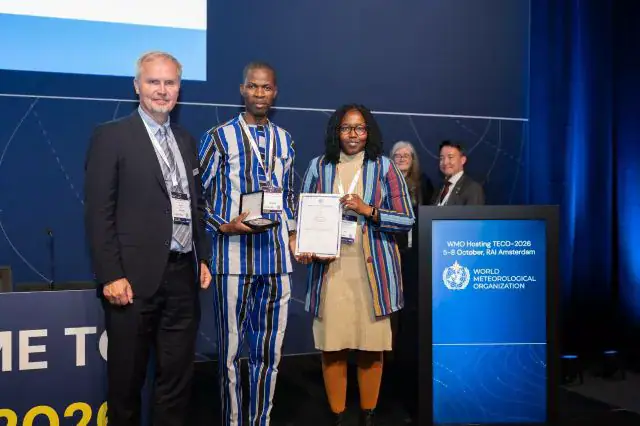
The Burkina Faso research team, led by Dr. Dieudonné SAMA, has been awarded the 11th Vilho Väisälä Prize by the World Meteorological Organization (WMO) for their innovative work on monitoring airport runways in real-time. The prize, which was presented on October 7, 2026, in Amsterdam, Netherlands, recognizes the team's groundbreaking research on automating the monitoring of runway conditions during rainfall. This achievement marks a significant milestone for Burkina Faso, as it becomes the second African country and the first in sub-Saharan Africa to receive this prestigious award.
The research team's winning article, titled "Global Reporting Format automation under rain: runway conditions monitoring in real time using Integrated Sensing and Communication technology," focuses on the development of a device that uses integrated sensing and communication technology to estimate the depth of water on airport runways in real-time. The device, which was tested at Ouagadougou International Airport, uses a radio link installed along the runway to measure the attenuation of the radio signal, allowing for accurate estimates of water depth. The results showed a strong correlation between the estimates and reference measurements, with a coefficient of determination of 0.87.
The Vilho Väisälä Prize is awarded by the WMO to recognize outstanding contributions to meteorological research and development. The prize is named after the Finnish meteorologist Vilho Väisälä, who made significant contributions to the field of meteorology. The prize includes a cash award of $10,000 and is considered one of the most prestigious awards in the field of meteorology. The Burkina Faso team's win is a testament to the country's growing expertise in meteorological research and development.
The research team's innovation has the potential to significantly improve air safety, particularly during periods of heavy rainfall. By providing real-time information on runway conditions, the device can help airport authorities make informed decisions about flight operations, reducing the risk of accidents. The device is also non-intrusive, cost-effective, and can operate continuously, making it an attractive solution for airports in developing countries.
The Burkina Faso team's achievement is also a reflection of the country's growing capacity for scientific research and development. The team, which includes Dr. Doua Allain GNABAHOU and engineer Ali GANAME, conducted the research at the University of Norbert ZONGO in Koudougou. The team's win is expected to inspire further innovation and research in the field of meteorology and aviation.
The WMO's recognition of the Burkina Faso team's research is also a testament to the organization's commitment to promoting innovation and excellence in meteorological research. The WMO's Technical Conference (TECO-2026) and Meteorological Technology World Expo 2026, which took place in Amsterdam, provided a platform for researchers and experts to share knowledge and showcase innovative technologies.
The Burkina Faso team's win is a significant achievement for the country's scientific community, and it is expected to have a positive impact on the country's reputation in the field of meteorological research. The team's research has the potential to be adapted and applied in other countries, particularly in Africa, where air safety is a major concern. The team's achievement is a source of pride for Burkina Faso and a motivation to continue investing in scientific research and development.
Key points
- The Burkina Faso research team won the 11th Vilho Väisälä Prize from the World Meteorological Organization for their innovative technology to monitor airport runways in real-time.
- The team's research focused on automating the monitoring of runway conditions during rainfall using integrated sensing and communication technology.
- The prize includes a cash award of $10,000 and is considered one of the most prestigious awards in the field of meteorology.