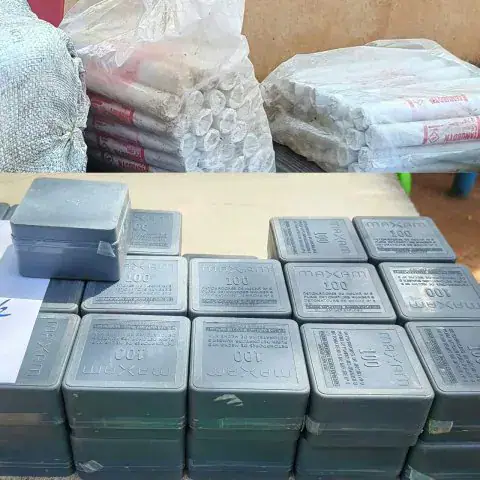
The Burkinabe customs authorities have announced the seizure of 2,310 explosive sticks and 7,500 detonators in two distinct operations. The seizures were made public by the General Directorate of Customs on October 27, 2026, in Ouagadougou. According to the customs officials, the explosive sticks were discovered following an accident involving a transit truck carrying drinks to Ouagadougou. The driver reportedly attempted to hide the products before being apprehended.
The second operation resulted in the seizure of 7,500 detonators, packed in 75 boxes of 100 units each and transported in a public transport bus. This seizure followed a surveillance operation that led to the arrest of two individuals allegedly involved in the trafficking. The driver of the truck carrying the explosives, Soukaïlou Ouédraogo, claimed he had accepted to transport the goods without knowing their exact nature. He stated that the goods were entrusted to him by an acquaintance in Ghana, with instructions to deliver them to the border.
Ouédraogo's explanations, however, have raised several questions. He claimed that he had been told the goods were for use in mines, but he did not suspect they were explosives. Following the accident, he panicked and attempted to hide the products. The Director-General of Customs, Dr. Yves Kafando, questioned Ouédraogo about why he had not declared the goods at the customs post and why he had tried to conceal them after the accident. Ouédraogo cited a commission he had accepted for the transport.
In the second operation, two individuals, Issa Sissao and Sory, were arrested in connection with the trafficking of 7,500 detonators. Sissao claimed that he regularly transported such products, allegedly for use in mining sites. However, this explanation has raised concerns about the actual destination of the goods. Sissao stated that the products were destined for sites in Côte d'Ivoire, but the Director-General of Customs questioned the logic of the route, which involved transporting goods from Ghana to Burkina Faso before re-exporting them to Côte d'Ivoire.
The seizures have been hailed as a success for the Burkinabe customs authorities, who have demonstrated their vigilance and professionalism in detecting the hidden goods. Dr. Yves Kafando warned those involved in smuggling activities that the authorities would continue to strengthen their efforts to combat such practices. He emphasized that the trafficking of hazardous materials posed significant risks to citizens' lives, the environment, and animals.
The Director-General of Customs also commended the agents involved in the operations for their commitment and urged them to maintain their level of vigilance. He noted that despite previous calls to abandon smuggling activities, some importers and traders continued to use strategies to evade customs controls. The authorities have recently toughened sanctions against those involved in such activities, in line with new legislation passed by the Legislative Assembly.
The Burkinabe authorities' efforts to combat smuggling and trafficking of hazardous materials are ongoing, with a focus on protecting citizens and the environment. The seizures serve as a reminder of the risks associated with the trafficking of explosives and the importance of cooperation between authorities and the public to prevent such activities.
Key points
- The Burkinabe customs authorities seized 2,310 explosive sticks and 7,500 detonators in two separate operations, highlighting the ongoing efforts to combat smuggling and trafficking of hazardous materials.
- The drivers and traffickers involved in the operations claimed that the goods were destined for use in mining sites, but the authorities have raised concerns about the actual destination of the goods.
- The authorities have warned those involved in smuggling activities that they will continue to strengthen their efforts to combat such practices, with a focus on protecting citizens and the environment.