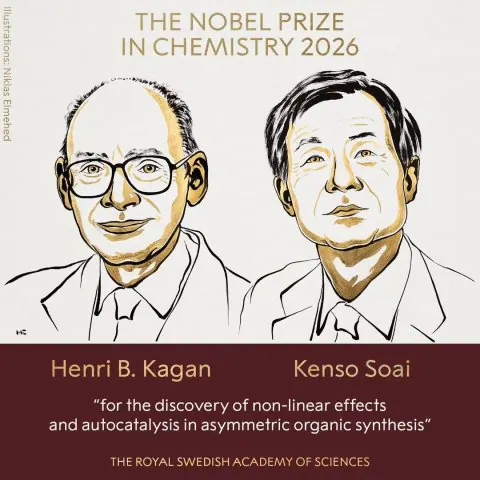
The 2026 Nobel Prize in Chemistry has been awarded to Henri B. Kagan and Kenso Soai for their groundbreaking work on molecular symmetry. For decades, chemists have been puzzled by the phenomenon of homochiralité, where living organisms use only one form of certain molecules. The two researchers have made significant contributions to understanding this process, paving the way for advancements in fields such as pharmaceuticals and materials science.
The concept of chirality, or molecular symmetry, has long fascinated chemists. Certain molecules exist in two forms that are mirror images of each other, but living organisms typically use only one form. This has significant implications for the production of molecules used in medicine, as the correct form is crucial for efficacy and safety. Kagan and Soai's work has provided valuable insights into this process, enabling the development of new methods for synthesizing molecules with specific properties.
Henri B. Kagan's 1986 discovery of a new method for manipulating chemical reactions marked a significant breakthrough in the field. His work enabled the production of molecules with a greater excess of one form over the other, a crucial step in the development of new pharmaceuticals and materials. Kenso Soai built on Kagan's work, describing a reaction that could become homochiral in 1995. His subsequent experiments in 2003 demonstrated the production of a single form of a molecule, a major milestone in the field.
The impact of Kagan and Soai's work extends beyond the laboratory, with significant implications for our understanding of the emergence of life on Earth. By understanding how homochiralité arises, scientists can gain insights into the fundamental processes that underlie living organisms. This knowledge has the potential to inform the development of new technologies and treatments, from pharmaceuticals to materials science.
The Nobel Prize in Chemistry is not the only scientific honor announced recently. The Nobel Prize in Physics was awarded to Francis Halzen for his contributions to the IceCube Neutrino Observatory and the discovery of high-energy neutrinos of astrophysical origin. This award highlights the importance of interdisciplinary research and the ongoing quest for scientific understanding.
While Kagan and Soai's work has been recognized with the Nobel Prize, it is worth noting that many African scientists have made significant contributions to scientific research, often in the face of significant challenges. The issue of brain drain and the challenges faced by African scientists is complex, with many factors at play. However, the recognition of scientists such as Kagan and Soai serves as a reminder of the importance of supporting and celebrating scientific achievement.
The 2026 Nobel Prizes serve as a testament to the power of human ingenuity and the importance of scientific research. As scientists continue to push the boundaries of knowledge, we can expect to see new breakthroughs and innovations that will shape the world of tomorrow. The work of Kagan and Soai is a reminder of the importance of fundamental research and its potential to transform our understanding of the world.
Key points
- Henri B. Kagan and Kenso Soai were awarded the 2026 Nobel Prize in Chemistry for their work on molecular symmetry and homochiralité.