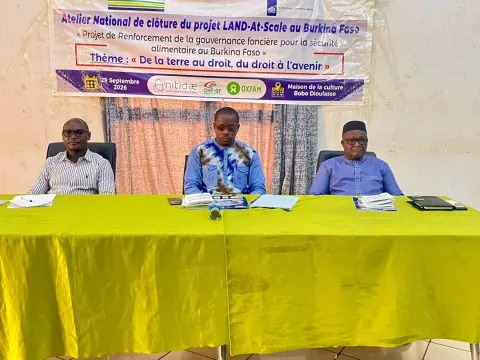
The Land-At-Scale project, also known as the "Project to Strengthen Land Governance for Food Security in Burkina Faso," officially ended on September 29, 2026, in Bobo-Dioulasso. The project was implemented by a consortium consisting of Nitidæ, Oxfam, and the National Observatory of Land in Burkina Faso (ONF-BF), with funding from the Netherlands Enterprise Agency. Its primary objective was to improve food security and resilience among women and young people by securing their access to land and strengthening land governance and management practices.
During its three-year implementation, the project focused on several areas, including awareness-raising, land tenure security, capacity building for local actors, conflict prevention, and economic valorization of secured lands. One of the project's key achievements was the production of 1,343 land tenure security documents, including 686 rural land possession certificates (APFR) issued to women and young people, with an additional 439 certificates in the process of being issued. As a result, approximately 5,116 individuals, including men, women, and young people, now have access to land documents.
The project also introduced and popularized the MAST (Mobile Application to Secure Tenure) tool, which enabled the registration of 4,232 hectares of land in the ten communes where the project was implemented. According to Issoufou Ganou, spokesperson for the consortium and representative of the National Observatory of Land, the project's goal was not only to produce documents but also to enable local actors to sustainably master land tenure security procedures. He noted that the project's interventions have contributed to strengthening the technical capacities of local land services.
The project emphasized local land governance and citizen participation, establishing nine citizen monitoring mechanisms for land governance through the Cellules d'interpellation citoyenne (CIC). These structures conducted 54 monitoring and information collection visits and organized 25 platforms for questioning communal authorities. Additionally, 186 Village Land Commissions (CFV) and 186 Village Land Conciliation Commissions (CCFV) were operationalized, contributing to the resolution of 305 land conflicts.
Emmanuel Ouédraogo, president of the special delegation of the commune of Satiri, praised the project's impact on reducing land-related tensions in his commune. He highlighted the strengthening of land services, support in processing APFR requests, and the establishment of CFV and CCFV as significant achievements. The project's focus on women and young people, who are particularly vulnerable in terms of land access, was also notable, with awareness-raising campaigns reaching approximately 360,000 people.
The project's economic valorization component involved supporting the formalization of 30 cooperatives, benefiting 1,354 individuals, and accompanying 15 women's and youth market gardening cooperatives and six large-scale crop cooperatives in exploiting their lands. According to the data presented at the project's closure, 850 small agricultural producers saw their productivity and incomes increase thanks to land tenure security, with inputs and small production equipment provided to them.
Representing the governor of the Guiriko region at the closure ceremony, technical advisor Souleymane Drabo commended the project's achievements, highlighting the importance of land in achieving food self-sufficiency. He emphasized that the project's results will contribute to the country's efforts to ensure food security and resilience, particularly for vulnerable groups such as women and young people.
Key points
- The project produced 1,343 land tenure security documents, including 686 rural land possession certificates (APFR) issued to women and young people.
- The project's interventions contributed to strengthening the technical capacities of local land services and improving land governance.
- The project supported the formalization of 30 cooperatives, benefiting 1,354 individuals, and accompanied 15 women's and youth market gardening cooperatives and six large-scale crop cooperatives in exploiting their lands.