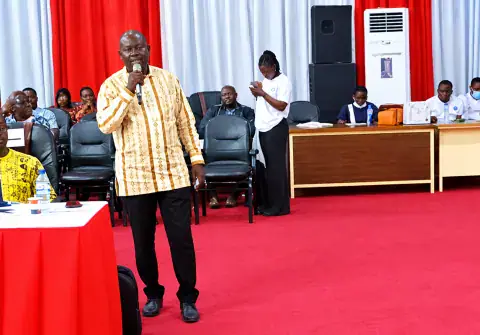
Dr. Mohamed Tidjane Kinda presented a paper titled "Promotion of Handicrafts in a Context of Revolution: The Case of Burkina Faso's Progressive and Popular Revolution" on Sunday, November 1, 2026. The presentation was part of the 18th edition of the International Exhibition of African Art and Craft (SIAO). Dr. Kinda emphasized that the handicraft sector must evolve from a traditional activity to a strategic pillar of the country's economic sovereignty.
The handicraft sector in Burkina Faso has shown remarkable vitality, with over 4,200 exhibitors in 2024, up from 244 in 1988. According to the National Institute of Statistics and Demography (INSD), there are nearly 177,566 handicraft units in the country. The sector provides direct and indirect employment to a significant portion of the active population. The agro-food, metal-mechanical, and textile-apparel sectors dominate the landscape.
Despite this growth, the sector faces persistent structural constraints. Dr. Kinda noted that the size of handicraft units, access to financing, and access to markets remain significant challenges. The use of manual tools has limited productivity and standardization, making it difficult for local artisans to compete with imported goods.
The concept of endogenous development is central to the vision of the progressive and popular revolution. The goal is to stop exporting raw materials and promote local processing. The cotton sector is a prime example, with a significant portion of export earnings, but the local value chain (spinning, weaving, and sewing) remains under-exploited. Initiatives like Faso Dan Fani demonstrate the potential for local production of clothing that meets national and export demands.
Dr. Kinda emphasized that economic sovereignty requires the country to develop its capacity to satisfy a growing portion of its needs through local production. He cited examples such as producing steel bars, school equipment, and textiles locally, which would create stable jobs and retain wealth within the country. To achieve this, Dr. Kinda proposed several operational axes, including the refoundation of the institutional and financial environment.
The creation of regional handicraft poles with shared tools and adapted credit mechanisms to finance equipment and working capital for artisans are part of the proposed solutions. Dr. Kinda also stressed the importance of securing commercial outlets through the promotion of "Made in Burkina" products. The Initiative for Quality Education (IPEQ) serves as a model, where local artisans produce school furniture, demonstrating the potential for integrating small producers into large public projects.
The success of this transformation will require strict monitoring and evaluation to measure the real impact on job creation, productivity, and import substitution. Dr. Kinda's vision aligns with the objectives of the 2026-2030 national development plan and the 2026-2028 industrial offensive, which emphasize local resource transformation, wealth creation, and reduced dependence on imports.
Key points
- The handicraft sector in Burkina Faso aims to transition from a traditional activity to a strategic pillar of economic sovereignty.
- The sector faces persistent structural constraints, including limited access to financing and markets.
- The promotion of "Made in Burkina" products and local production is crucial for achieving economic sovereignty.