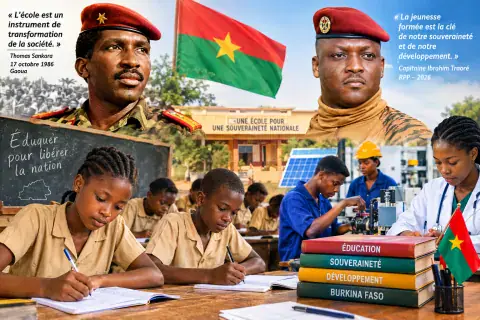
On October 17, 1986, Thomas Sankara launched the Appel de Gaoua, a call to action that emphasized the importance of quality education in transforming Burkinabè society. Forty years later, the country, under the leadership of Captain Ibrahim Traoré, is engaged in a national refoundation effort, with education occupying a strategic position. The question arises: should Burkinabè schools merely transmit knowledge or become an instrument of national sovereignty, emancipation, and transformation?
Sankara's Revolutionary Democratic and Popular (RDP) movement sought to break away from colonial-era structures, with education being a crucial tool for societal transformation. He recognized that political independence without intellectual independence was incomplete. A country could have its own flag, national anthem, and institutions but still depend on others for policy-making, engineering, technology production, and historical interpretation. The Appel de Gaoua called for collective responsibility in education, involving not only teachers but also parents, students, administrators, and the entire national community.
The RDP's focus on education was rooted in the idea that it should be a national responsibility, not just the concern of the ministry in charge of education. Sankara's vision was to create a pedagogy of emancipation, where learning would lead to understanding, production, and ultimately, liberation from national dependencies. This approach aimed to bridge the gap between the school and the country's realities. In contrast, the current Revolutionary Progressive and Popular (RPP) movement, led by Captain Traoré, operates in a different historical context, with additional challenges such as insecurity, population displacement, technological globalization, and industrial needs.
The RPP's educational reform agenda includes teaching national languages, introducing English, civic education, vocational training, and integrating general education with professional training. A decree adopted by the Council of Ministers on May 7, 2026, aims to break down barriers between different forms of education. This development signifies a shift towards a more pragmatic approach to sovereignty, focusing on producing competent nationals in various fields, such as agriculture, engineering, technology, and healthcare.
The debate surrounding the introduction of revolutionary values in education is often contentious. Some argue that it constitutes a politicization of schools, while others see it as a necessary aspect of national development. In reality, no educational system is entirely detached from the societal project in which it operates. All systems, whether liberal democracies or socialist states, prioritize certain values and principles in their educational frameworks.
Burkina Faso's educational reforms reflect its unique historical and cultural context. The country's leaders recognize that education must serve the nation's development needs, fostering a sense of patriotism, responsibility, and competence among its citizens. By reorienting its education system, Burkina Faso aims to build a more self-sufficient and productive society, capable of addressing its internal and external challenges.
As Burkina Faso continues on its path of national refoundation, the role of education in shaping the country's future will remain crucial. The government's commitment to educational reform and the emphasis on vocational training, civic education, and national languages are steps towards creating a more skilled and engaged citizenry. The success of these efforts will depend on the ability of educators, policymakers, and the broader national community to work together in shaping a more prosperous and sovereign Burkina Faso.
Key points
- Education is a strategic pillar in Burkina Faso's national refoundation effort under Captain Ibrahim Traoré.