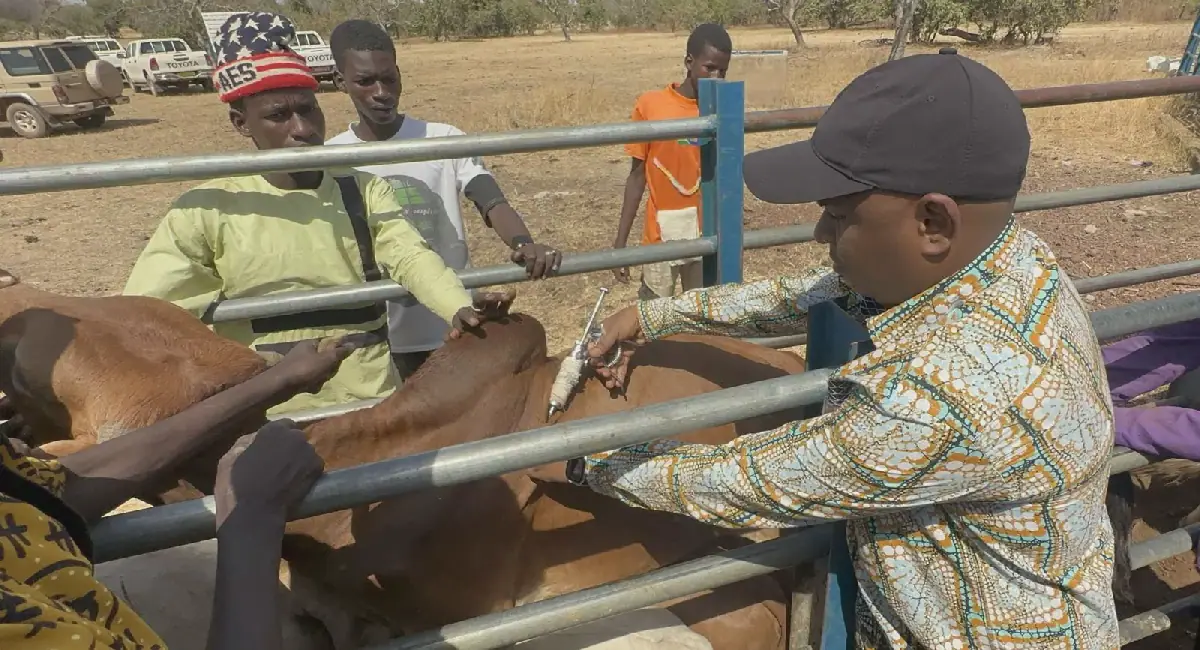
The Burkinabè government has launched a campaign to strengthen animal health and improve national livestock productivity through vaccination against priority animal diseases and artificial insemination. The campaign, led by Minister of Animal Resources Dr. Amadou Dicko, targets 100,000 cows for insemination and vaccination against several priority diseases, including contagious bovine pleuropneumonia, peste des petits ruminants, Newcastle disease, and African swine fever.
Dr. Amadou Dicko recently toured the Nando and Bankui regions to assess the campaign's progress and encourage producers to participate. The campaign is part of the government's 2026-2028 Agro-Pastoral, Hydraulic, and Fisheries Offensive, aiming to transform over 75 million liters of milk and improve the genetic potential of cattle. The vaccination program seeks to control and eliminate certain animal diseases by 2030.
In the Nando region, vaccination coverage varies by disease, with 10% of the 600,000 targeted cattle vaccinated against contagious bovine pleuropneumonia. However, the region has achieved 40% vaccination coverage for Newcastle disease and 50% for peste des petits ruminants. Regional Director of Animal Resources and Fisheries Antoine Zorma attributes the low vaccination rate to implementation challenges.
The Bankui region reports encouraging results, with over 80% vaccination coverage for peste des petits ruminants. Regional Director S. Gaël Yaméogo credits the success to strong producer mobilization and effective technical services. As of November 24, 2026, 232 cows had been inseminated in the region, with authorities aiming to improve this number throughout the campaign.
Artificial insemination is a key strategy for transforming Burkinabè livestock by improving cattle genetics and enhancing milk and meat production. The Ministry of Animal Resources also plans to digitalize animal identification through bolus placement, enabling breeders and veterinary services to track animal origin, health history, and prevent cattle theft.
Dr. Amadou Dicko's tour of Nando and Bankui demonstrates the government's commitment to monitoring the campaign's progress. The initiative is crucial to achieving food sovereignty and economic development in Burkina Faso. Authorities aim to make animal health and genetic improvement pillars of the country's agricultural sector.
The campaign's success will depend on continued producer participation and effective implementation. With the right strategies and resources, Burkina Faso can improve animal health, increase livestock productivity, and achieve its agricultural goals. The government's efforts to enhance animal health and productivity will have a positive impact on the country's food security and economy.
Key points
- The Burkinabè government aims to vaccinate 100,000 cows and improve the genetic potential of cattle through artificial insemination.
- The campaign targets several priority diseases, including contagious bovine pleuropneumonia, peste des petits ruminants, Newcastle disease, and African swine fever.
- Authorities aim to control and eliminate certain animal diseases by 2030 and transform over 75 million liters of milk.