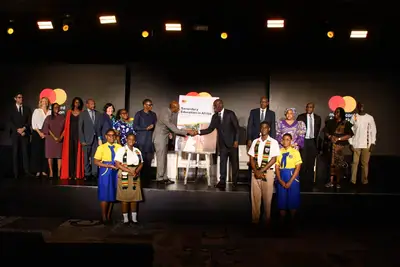
The Mastercard Foundation has launched a report titled Secondary Education in Africa: Expanding Pathways to Work, Livelihoods, and Lifelong Learning in Accra, Ghana. The report emphasizes that African school systems can no longer operate as narrow pipelines to university, as only 9% of sub-Saharan African youth reach tertiary education. Mastercard Foundation president and chief executive Sewit Ahderom stated that secondary school is the last time a system reaches most young Africans at scale, making it a critical point for intervention.
South Africa's Department of Basic Education is preparing for a full national rollout of its General Education Certificate in 2027. The certificate pairs school-based assessment with centrally developed curriculum tests and an inclinations assessment to channel learners into academic, technical-vocational, or technical-occupational streams. However, two major international assessments suggest that while South Africa's policy architecture is ahead of the continental curve, the practical pathways behind it remain thin. The Organisation for Economic Co-operation and Development cautioned that the Grade 9 qualification must not become a "ticket to leave school" in a country where only 1% of 15- to 19-year-olds are enrolled in upper-secondary vocational education.
The OECD data shows that just 12% of South African secondary schools offered technical subjects in 2024, and fewer than 5% of matric candidates sat for them. A tracer study of nearly 4,000 Technical and Vocational Education and Training college graduates found that 45.3% were unemployed 12 to 18 months after qualifying, with only 16.6% securing employment. This bottleneck mirrors a broader continental crisis, with more than half of enrolment losses occurring before learners reach secondary school or during the transition from lower to upper secondary.
The Mastercard Foundation report highlights the importance of flexible pathways to opportunity, not second-class routes through education. Director of evidence and learning insights Eunice Muthengi emphasized that technical pathways frequently stall due to social stigma, outdated equipment, weak employer links, and severe exclusion. The report points to weaknesses in the "middle tier" of education systems, including district offices tasked with translating national curriculum policy into classroom practice.
South Africa's Three-Stream Model is being watched closely across the continent as a test of multi-pathway reform at scale. However, the report warns that the implementation gap in townships and districts is significant. Without adequately staffed district teams, equipped workshops, and retrained teachers, township and rural schools struggle to offer genuine technical streams, leaving learners stuck in default academic tracks.
South Africa has structural advantages over many regional peers, including an average of 10.5 years of schooling, equivalent to 8.1 learning-adjusted years once literacy is factored in. The country has also begun introducing coding and robotics into school curricula, while its green economy already accounts for more than 10% of national employment. By contrast, Rwanda has doubled upper-secondary vocational enrolment to roughly 40% by combining workplace learning with employer curriculum input and systematic graduate tracking.
Any credible pathway in South Africa and the wider region must also reckon with the structure of African labour markets. More than 10 million young people enter the workforce annually to compete for roughly three million newly created formal jobs. Bridging Africa's secondary education financing gap requires an estimated $82 billion a year, yet only 22 of 42 countries with data meet recommended GDP spending benchmarks.
Key points
- The Mastercard Foundation report urges African governments to replace single-track academic schooling with credible routes to work.
- South Africa's Grade 9 certificate must not become a "ticket to leave school" without viable alternative pathways.
- The implementation gap in townships and districts is a significant challenge to South Africa's Three-Stream Model.