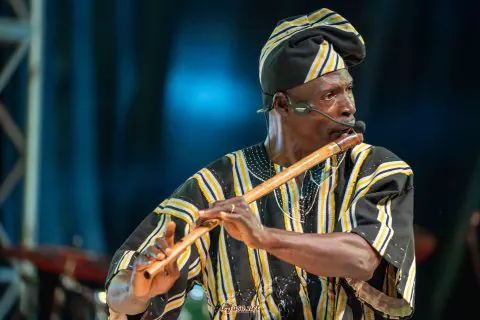
Amzi Franc, whose real name is Ouattara Niapéguéssin, has been enchanting audiences with the captivating sounds of the talking flute for two decades. His journey into music began at a young age, influenced by his father's profession as a flautist. This early exposure sparked a passion that would shape his life's work. Amzi Franc's story is one of dedication and perseverance, as he pursued his musical ambitions despite facing skepticism from some family members and the challenges of establishing himself in a less mainstream musical tradition.
Born into a family that wasn't traditionally associated with music, Amzi Franc faced some resistance when choosing to become a musician. However, his father, who was himself a flautist, supported his decision. Amzi Franc's musical education began in earnest when he entered the Petit Séminaire de Nasso in 1988. There, he was introduced to various musical instruments, including the recorder and guitar. His inclination towards music eventually led him to abandon his plans to become a priest, opting instead to pursue a career in music.
A significant turning point in Amzi Franc's career came in the early 2000s when he discovered the music of the renowned flautist Bassirou Sanou through radio broadcasts. Inspired by Sanou's mastery of the traditional flute, also known as the "nerve flute" or "Guinean flute," Amzi Franc sought out the opportunity to learn from him. However, acquiring the instrument proved costly, with a price tag of 15,000 CFA francs, a substantial amount at the time. It wasn't until 2004, when he won a music competition and used his prize money to purchase his first flute, that his intensive study of the instrument began.
Since acquiring his flute, Amzi Franc has dedicated himself to mastering his craft. Over the years, he has shared the stage with numerous acclaimed musicians, including Issouf Diarra, now a member of the Faso Presidency's orchestra. In 2006, he joined the company of choreographer Oumar Ouédraogo, participating in multiple editions of the National Culture Week (SNC) and representing Burkina Faso internationally. Notable performances include the 2009 Francophonie Games in Lebanon and various festivals in France.
Throughout his career, Amzi Franc has released three albums: the first in 2011, the second in 2019, and the third in 2021. Beyond music, he is committed to preserving and transmitting the cultural heritage associated with his instrument. Currently, he is working on a book about the flute he plays and its fabrication, aiming to share his knowledge with future generations. This project reflects his broader mission to promote the flute as an instrument of peace and social cohesion.
For Amzi Franc, the flute is more than a musical instrument; it holds spiritual and therapeutic dimensions. He believes the flute promotes peace, calms, and evokes deep sensations, even possessing healing properties. Despite his achievements and recognition, Amzi Franc notes that artists working in traditional music often face challenges related to visibility and promotion. He advocates for more opportunities and support from event organizers and authorities to help lesser-known artists gain exposure and sustain themselves through their art.
As Amzi Franc continues his journey with the talking flute, he remains committed to his art and its potential to bring people together. His story serves as a testament to the power of passion and perseverance in pursuing one's vocation, even in the face of adversity. With his upcoming book and ongoing musical projects, Amzi Franc is poised to leave a lasting legacy, not only as a master flautist but also as a cultural ambassador for Burkina Faso.
Key points
- Amzi Franc has spent 20 years mastering the talking flute, an instrument he views as a tool for peace and social cohesion.
- Despite his accomplishments, he highlights the challenges faced by artists in traditional music, particularly in terms of visibility and promotion.
- Amzi Franc is working on a book about the flute and its fabrication, aiming to preserve and transmit its cultural significance.