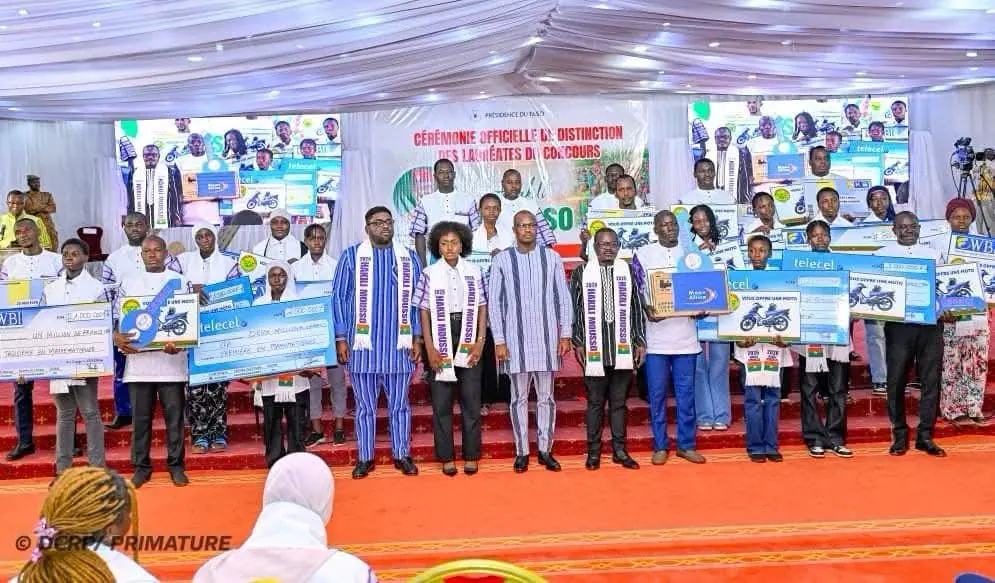
The first edition of the Hakili Mousso national competition for female scientific talents took place on September 19, 2026, in Ouagadougou, Burkina Faso. The event aimed to recognize and reward the best female candidates in scientific fields, particularly in mathematics, physics, and chemistry. The competition, initiated by President Captain Ibrahim Traoré, seeks to encourage young girls to pursue scientific studies and contribute to the country's development. A total of 84 candidates participated in the final phase of the competition.
The winners and their teachers were awarded various prizes, including motorcycles, fuel vouchers, and checks with varying amounts. The laureates will also receive support for their university education, including accommodation, meals, free transportation, and health insurance. The teachers who mentored the winners were also recognized for their contribution to the candidates' success, receiving motorcycles, fuel vouchers, and a villa. The prizes were presented during a ceremony attended by the Minister-Counselor to the Head of State, Floriane Zongo.
Minister-Counselor Floriane Zongo highlighted the disparities between girls and boys in scientific education, citing statistics that show girls are underrepresented in scientific fields. According to the data, girls made up 52.6% of those who passed the BEPC exam in 2023, but only 23.5% of those who passed the scientific baccalaureate in 2026. In higher education, women accounted for 36.7% of students in scientific fields in the 2025-2026 academic year. Zongo encouraged young people, both girls and boys, to take an interest in science to contribute to the country's development and sovereignty.
The competition was organized in two phases, with a regional selection process identifying the best baccalaureate candidates in mathematics, physics, and chemistry. The 84 candidates who participated in the final phase were from various regions of the country. The Minister-Counselor praised the work of the organizing committee, pedagogical committee, and partners who contributed to the success of the competition. She also thanked the authorities and structures involved in its implementation, including the ministries responsible for secondary and higher education.
The laureates expressed their gratitude to the authorities and organizers for the initiative. Nicole Ouattara, spokesperson for the winners, praised the conditions provided during their stay at the National Scientific High School in Ouagadougou, including transportation, meals, and accommodation. She assured that the participants intended to use their skills to serve Burkina Faso and become ambassadors of science. One of the winners, Ines Marie, who came first in chemistry, expressed her joy and satisfaction, revealing that she had prepared intensively with the support of her teacher.
The competition's goal is to value female scientific talents, encourage young girls to pursue scientific studies, and contribute to the development of Burkina Faso. The event also highlighted the importance of teacher support in the success of the candidates. Dembélé Dramane Samou, a physics teacher at the National Scientific High School in Bobo-Dioulasso, encouraged young learners to persevere in their studies, be disciplined, and cultivate ambition, particularly in mathematics and physics.
The Hakili Mousso competition is an initiative of the President of Faso, Captain Ibrahim Traoré, aimed at promoting the scientific talents of young girls and encouraging them to pursue careers in science. The event is a significant step towards addressing the underrepresentation of women in scientific fields in Burkina Faso. The winners and their teachers were congratulated on their achievement, and the organizers were commended for their efforts in promoting scientific education.
Key points
- The competition awarded prizes and support to 84 female scientific talents and their teachers.
- The event aimed to encourage young girls to pursue scientific studies and contribute to Burkina Faso's development.
- The competition's results showed a need to address the underrepresentation of women in scientific fields in Burkina Faso.