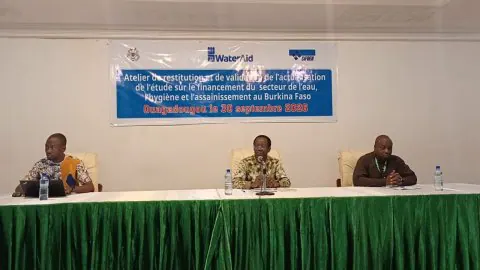
An atelier was held in Ouagadougou on September 30, 2026, to review and validate a retrospective and prospective study on the financing of the water, hygiene, and sanitation (WASH) sector in Burkina Faso. The study, commissioned by WaterAid and conducted by the Centre d'information, de formation et d'études sur le budget (CIFOEB), analyzed financing from 2017 to 2025 and provided recommendations to improve resource mobilization and effectiveness.
The WASH sector in Burkina Faso faces significant challenges, including a security crisis, climate change, population growth, and decreased external financing. WaterAid's country director, Dr. Lucien Damiba, emphasized the importance of reliable data to inform public decisions, citing the impact of successive crises on living conditions and increasing needs for clean water, hygiene, and sanitation.
According to Dr. Damiba, the current rate of access to clean water is 78.9%, while access to sanitation is around 29%, highlighting the need for further efforts to meet population needs, particularly in the context of forced displacement and urbanization. The study examined three primary financing instruments: resources allocated in finance laws, the Compte d'affectation spéciale du trésor (CAST), and direct financing by NGOs and development organizations.
The study found that between 2017 and 2025, 783.03 billion CFA francs were allocated to the WASH sector, averaging around 87 billion CFA francs per year. Direct financing plays a significant role in WASH resources, but this raises concerns about traceability and coordination. Dr. Aïda Dao, a researcher at CIFOEB, noted that the lack of a mechanism to track financing and interventions may impact the complementarity of actions and the achievement of universal access to WASH services.
The study also revealed a downward trend in WASH financing as a proportion of GDP, averaging 0.81% per year from 2017 to 2025, which is considered low given the scale of needs. Furthermore, spending on social WASH per capita decreased from 3,192 CFA francs in 2017 to 2,027 CFA francs in 2025, despite a slight improvement in 2024.
The geographic distribution of social WASH financing showed that 53.95% of resources were allocated to urban areas, while 46.05% went to rural areas. However, the study noted an evolution in favor of rural investments, particularly in the water sector, with significant progress in rural water investments from 2019 onwards.
The study highlights the dependence of the WASH sector on public development aid and the need for more effective and sustainable financing mechanisms. Key recommendations include improving the traceability and coordination of interventions, increasing investment in the sector, and reducing disparities between urban and rural areas.
Key points
- The study analyzed 783.03 billion CFA francs in WASH sector financing from 2017-2025.
- The WASH sector faces significant challenges, including a security crisis and decreased external financing.
- The study recommends improving the traceability and coordination of interventions to achieve universal access to WASH services.