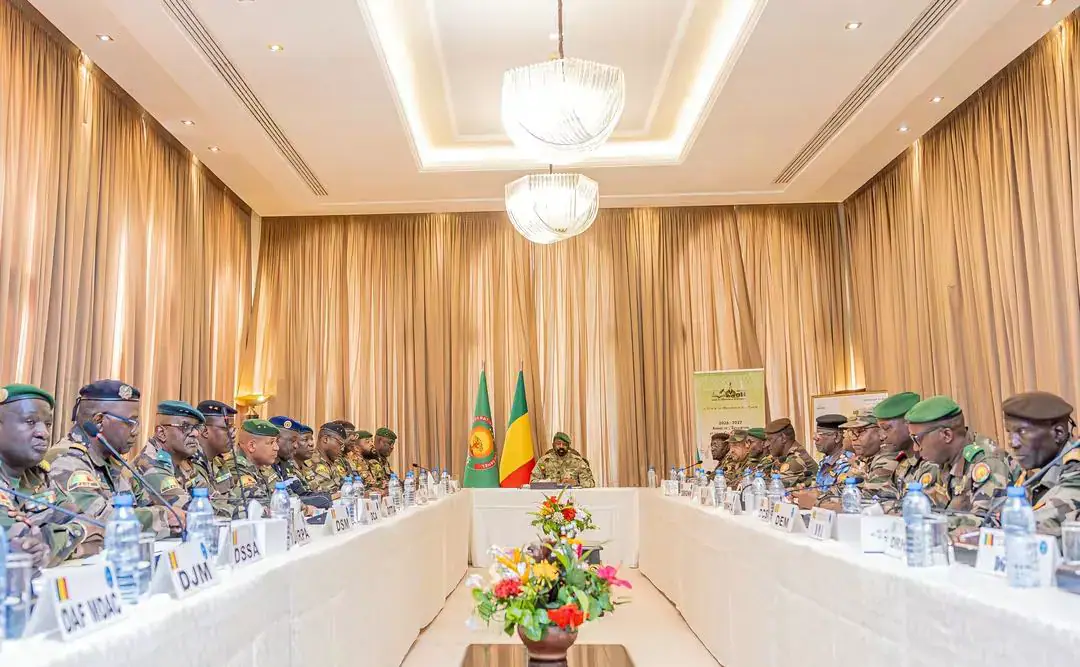
On November 24, 2026, in Koulouba, Burkina Faso's Transitional President General Assimi Goïta led a meeting with the Chiefs of Staff and Directors of Defense and Security Forces. The objective was to assess the situation of the forces, strengthen command coherence, and define strategic and operational priorities for national defense. The discussions focused on the organic and operational situation of the Armed Forces of Burkina Faso (FAMa), their capacity reinforcement, and organizational adaptation to combat security threats.
The meeting allowed the Supreme Commander of the Armed Forces to clarify his orientations for consolidating the growth of the FAMa and increasing their effectiveness on the ground. The exchanges addressed the current state and operational capacity of the FAMa, as well as their organizational reinforcement and adaptation to security threats. President Goïta emphasized the importance of these orientations in ensuring the military's efficiency.
Following the meeting, Minister Delegate to the Minister of Defense and Veterans, General Oumar Diarra, highlighted the significance of this consultation in ensuring military action coherence. He stated that the President's orientations focus on the strategic vision of the department, the Military Orientation and Programming Law (LOPM), human resource management, operations management, and cooperation with partners.
The Chief of General Staff of the Armed Forces, General Élysée Jean Dao, presented the operational situation and efforts made since taking command. He detailed that presidential directives concern reinforcing personnel and equipment, improving FAMa organization, and consolidating achievements on the ground. General Dao's presentation aimed to align the military's actions with the President's strategic objectives.
President Goïta praised the progress made and encouraged continued operations to maintain pressure on terrorist armed groups. He also stressed the importance of strengthening the capacities of the Unified Force of the Alliance of Sahel States (AES), in a spirit of solidarity and coordination against common threats. The President's emphasis on cooperation and coordination reflects the regional approach to security challenges.
This meeting demonstrates the Head of State's commitment to maintaining regular dialogue with military commanders, understanding ground realities, and providing adapted responses to Defense and Security Forces' needs. It is part of a dynamic to consolidate operational capacities and implement defense and security strategic priorities. The meeting's outcomes are expected to enhance the military's operational effectiveness.
The discussions and directives from the meeting are set to guide the military's actions in the coming period, with a focus on addressing security threats and improving the military's capabilities. The Transitional President's engagement with the military command underscores the government's commitment to national defense and security. The situation on the ground will likely continue to influence the military's strategic priorities.
Key points
- The meeting focused on assessing the situation of Burkina Faso's Armed Forces and defining strategic priorities for national defense.
- President Goïta emphasized the importance of cooperation and coordination with regional allies in addressing security challenges.
- The government's commitment to national defense and security was underscored by the Transitional President's engagement with the military command.