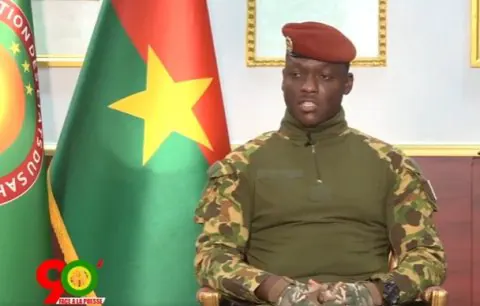
In a recent 90-minute televised interview, Burkina Faso President Captain Ibrahim Traoré outlined his country's economic policy, emphasizing the need to balance private initiative with a stronger role for the state. He responded to criticism from some economic actors who feel marginalized, rejecting the idea of a hostile policy towards the private sector. According to the President, the problem lies not with the private sector itself, but with an outdated economic model based on close ties to political power, massive imports, and the neglect of essential sectors.
Captain Traoré argued that those in the private sector who feel "crushed" by the government's policies are likely those who previously benefited from close relationships with politicians. He stated, "If someone in the private sector thinks they're being suffocated, it's because they were dining with politicians. That's all. And we will never allow that." The President emphasized his desire to orient the economy towards meeting the fundamental needs of the population, prioritizing the collective interest over individual privileges.
The President called on economic operators to shift their focus from imports to local production and exportation. He cited the example of the TEXFORCES Burkna Faso industry, encouraging traders who previously imported pagne to instead turn to national production units. "It's time to go to our factory, ask them to produce the design you want, find markets abroad to export it, but no longer import, because you'll come to kill our economy," he said.
Captain Traoré noted that there are already positive developments in the agro-food transformation sector, such as the multiplication of mills and local maize couscous production. He expressed regret that, in the past, the country imported all its couscous despite producing maize. The President also emphasized the importance of the state playing a significant role in strategic sectors, particularly extractive industries.
According to Captain Traoré, the state has a responsibility to exploit its natural resources. "The state must exploit its raw materials. That's the role of the state," he insisted. He also highlighted the need for the private sector to participate in the country's industrialization, while ensuring that the state's priorities are aligned with the needs of the population.
The President's economic policy aims to promote a more equitable distribution of resources, with a focus on satisfying the basic needs of the population. He contrasted this approach with the previous model, which he described as favoring a privileged few. "We've said there won't be champagne for a select few; we want clean water for everyone," he said.
Captain Traoré's government has made progress in reducing terrorism, and he expressed confidence that the country's economic policies will yield positive results. The President's vision for the economy has generated interest and discussion, both within Burkina Faso and across Africa. His administration's efforts to prioritize the needs of the population and promote local production and exportation are seen as key components of this strategy.
Key points
- Captain Ibrahim Traoré rejects the idea of a hostile policy towards the private sector
- The President emphasizes the need for local production and exportation over imports
- The government's economic policy prioritizes meeting the fundamental needs of the population