In Burkina Faso, a healthcare initiative is underway to bridge the language gap between healthcare workers and patients. The Ministry of Health's caravan of press, organized as part of the Month of Health Communication in National Languages, recently stopped in Kokologo, a town in the Nando region. At the local medical center, healthcare workers are making an effort to communicate with patients in their native languages. This approach aims to overcome linguistic barriers that can hinder access to healthcare.
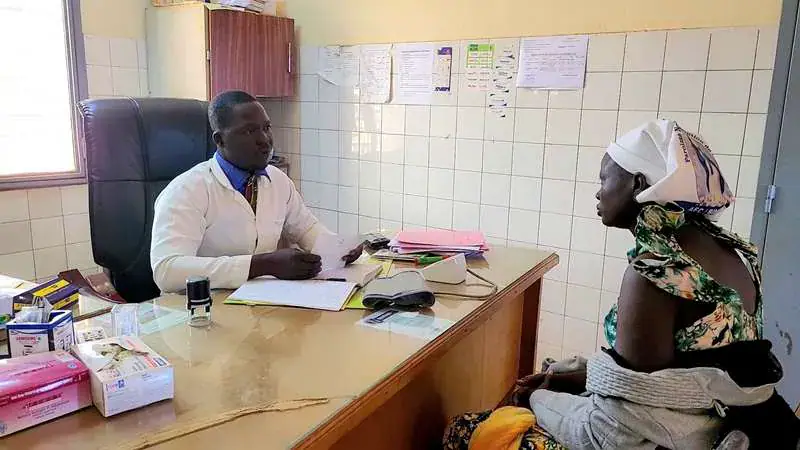
At the Kokologo medical center, healthcare workers are adapting to patients' linguistic needs. For example, midwives are discussing patients' concerns in Mooré, a national language spoken in the region. Fadilatou Kaboré, a pregnant woman, recently had a consultation at the center. She appreciated the midwife's effort to communicate in Mooré, which helped her understand the discussion better. Kaboré suggested that having medical prescriptions in national languages would further improve her understanding.
Raïssa Ouérécé/Kaboré, a midwife at the Kokologo medical center, has made a conscious effort to learn the local language. She previously worked in the Sahel region, where she relied on interpreters to communicate with patients. However, she decided to learn the local language to ensure her message was conveyed accurately. Her approach has been successful, and she is now confident in her ability to communicate with patients in their native languages.
The use of national languages in healthcare has several benefits, according to Alassane Ouédraogo, the chief medical officer at the Kokologo medical center. When healthcare workers communicate in patients' native languages, they can convey messages more effectively and provide detailed explanations during health education sessions. This approach has contributed to increased mobilization and participation in health initiatives, such as the recent campaign against dengue fever.
The Month of Health Communication in National Languages has had a significant impact on health education and mobilization in Burkina Faso. The initiative has enabled healthcare workers to reach a wider audience and address specific health concerns, such as dengue fever and nutrition. Radio broadcasts have also been organized, featuring healthcare specialists who provide information and answer questions from the public.
The use of national languages in healthcare has been well-received by the local population. Patients appreciate the effort made by healthcare workers to communicate in their native languages, which helps them understand health information better. The initiative has also contributed to increased participation in health education sessions and radio broadcasts.
The Ministry of Health's initiative aims to make health communication more accessible and effective by using national languages. By doing so, healthcare workers can build trust with patients and provide them with accurate health information. The success of this initiative could lead to its expansion to other regions in Burkina Faso, ultimately improving healthcare outcomes for the local population.
Key points
- Healthcare workers in Burkina Faso are using national languages to improve communication with patients.
- The initiative has contributed to increased mobilization and participation in health education sessions.
- The use of national languages has helped patients understand health information better.