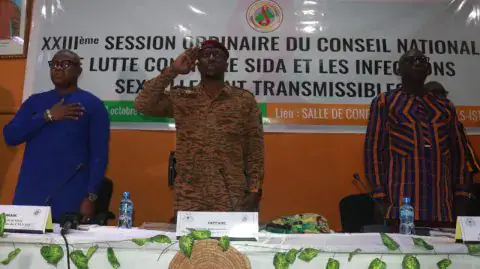
The 23rd ordinary session of the National Council for the Fight Against AIDS and Sexually Transmitted Infections (CNLS-IST) was held on October 28, 2026, in Burkina Faso. The meeting was presided over by Captain Martha Anderson Meda, Minister Director of Cabinet, representing the President of Faso, who is also the President of CNLS-IST. The session reviewed the implementation of recommendations from the 22nd session, the annual report of the National Multisectoral Plan to Fight Against HIV and STIs, and validated the new National Strategic Plan against HIV, AIDS, and STIs for 2026-2030.
According to the data presented by Captain Martha Anderson Meda, 87,534 people are receiving antiretroviral treatment, and 93% of people living with HIV know their serological status. In terms of preventing mother-to-child transmission of HIV, 95.4% of pregnant women received prenatal consultations and were screened, and nearly all those with positive test results (0.57%) were put on treatment. These results are attributed to the commitment of various stakeholders, free healthcare, and biological monitoring, as well as the decentralization of care.
In 2025, the estimated number of people living with HIV in Burkina Faso was 91,000, including 5,800 children, with 1,600 new infections and 1,800 deaths. Statistics show that only 29% of children living with HIV are identified and receiving treatment, and 19% have suppressed viral loads. The regions most affected are Kadiogo (1.30%), Nakambé (0.65%), Guiriko (0.64%), Nando (0.63%), and Oubri (0.62%).
Despite the undeniable progress made in the fight against HIV and STIs, several challenges could compromise the goal of eliminating the disease as a public health threat by 2030. Captain Anderson Meda identified five major challenges, including suppressing viral loads, improving care for children, strengthening prevention among high-risk populations, addressing treatment resistance, and securing funding.
To address these challenges, Burkina Faso has developed a new National Strategic Plan to fight against HIV, AIDS, and STIs from 2026 to 2030. The plan aims to reduce new infections by 95%, mortality by 95%, and improve the quality of life for 95% of people living with HIV, orphans, and vulnerable populations. The plan also seeks to establish robust and sustainable governance systems and will require 138.12 billion FCFA for implementation, with the state committed to providing at least 50% of the funding.
The new strategic plan was validated unanimously by the members of the CNLS-IST, and the council made several recommendations, including strengthening service delivery approaches, intensifying early screening for children, and improving pediatric care. The plan aims to align interventions with national priorities and mobilize necessary resources to eliminate HIV as a public health threat by 2030.
Partners and financial stakeholders, represented by Ernest Moïse Mushekuru, reaffirmed their commitment to supporting the government in strengthening differentiated service delivery approaches and addressing the specific needs of affected populations, including internally displaced persons and returnees.
Key points
- The new National Strategic Plan aims to reduce new HIV infections by 95% and mortality by 95% by 2030.
- Burkina Faso has maintained an HIV prevalence of 0.5% in the general population, with 87,534 people receiving antiretroviral treatment.
- The plan requires 138.12 billion FCFA for implementation, with the state committed to providing at least 50% of the funding.